
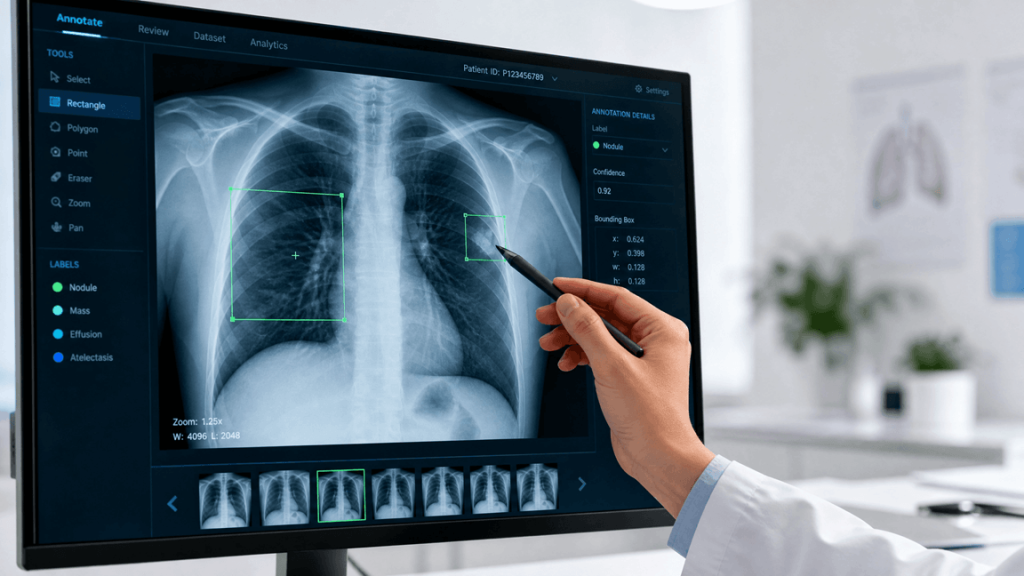
In the rapidly evolving landscape of 2026, Artificial Intelligence (AI) has moved from a futuristic promise to a core component of modern medicine. From detecting early-stage carcinomas in radiology to predicting sepsis in intensive care units, AI’s potential to save lives is unmatched. However, as the saying goes, “An AI is only as good as its data.”
While automation and synthetic data have accelerated development, the industry is reaching a consensus: The Gold Standard for Healthcare AI is Human-in-the-Loop (HITL) annotation. In a field where a single mislabeled pixel can lead to a misdiagnosis, the “human touch” is not just a preference—it is a clinical and legal necessity.
The Stakes of Precision: Why “Good Enough” Isn’t Enough in Healthcare
In traditional computer vision, mislabeling a “cat” as a “dog” results in a minor user experience glitch. In medical AI, mislabeling a benign cyst as a malignant tumor—or worse, missing a subtle fracture—has life-altering consequences.
Medical data is inherently complex, high-dimensional, and often “gray.” Unlike standard image sets, medical images (DICOM, WSI) and clinical notes require a level of nuance that automated systems frequently miss. This is why Synnth AI prioritizes high-fidelity, expert-verified data structures to ensure that AI models are grounded in medical reality.
The Limits of Automated Labeling
Purely automated labeling systems rely on patterns. However, medicine is often defined by the anomalies—the “edge cases.”
- Anatomical Variations: No two human bodies are identical. Automation often struggles with natural variations in anatomy that a trained radiologist would recognize as normal.
- Pathological Nuance: Distinguishing between different stages of a disease requires more than pattern recognition; it requires clinical judgment.
- Artifacts and Noise: Medical images often contain “noise” from movement or equipment. Humans can filter this out; AI might inadvertently learn the noise as a diagnostic feature.
Why Human Expertise is Irreplaceable in 2026
As we navigate 2026, the role of the medical professional in AI development has shifted from a mere “reviewer” to a critical “collaborator.” Here is why human expertise remains the cornerstone of data quality.
1. Navigating Clinical Subjectivity
Medical diagnosis is rarely black and white. It involves a synthesis of patient history, physical examination, and diagnostic tests. When annotating data, a human expert can provide the context that a machine lacks. For instance, an AI might flag a specific shadow on a lung X-ray, but a human annotator knows to correlate that with the patient’s clinical history of pneumonia.
2. Handling Rare Diseases and Edge Cases
Large Language Models (LLMs) and computer vision models thrive on massive datasets. But what happens with rare diseases where only a few hundred cases exist globally? Automated systems cannot “guess” their way through rarity. Human experts use their years of medical school and residency to identify patterns in data that are too sparse for a machine to learn independently.
3. Ethical and Bias Mitigation
Data bias is a silent killer in Healthcare AI. If a model is trained primarily on data from one demographic, its accuracy drops significantly for others. Human-in-the-loop workflows allow for active bias detection. Human annotators can identify if certain populations are underrepresented or if the AI is picking up on “proxy variables” that could lead to unethical outcomes.
The Rise of Hybrid Models: Synthetic Data Meets Human Verification
One of the biggest breakthroughs in 2026 is the synergy between synthetic data and human oversight. Synnth AI has pioneered this space by using advanced generative models to create privacy-compliant, statistically accurate patient records and images.
However, Synnth AI recognizes that synthetic data must be “anchored” in truth. By using a hybrid approach, developers can:
- Scale with Synthetic Data: Use Synnth AI to generate millions of data points to cover every possible scenario, including rare edge cases.
- Verify with Humans: Use medical experts to audit a curated subset of the synthetic data, ensuring it maintains “clinical plausibility.”
This hybrid method provides the best of both worlds: the speed of automation and the clinical safety of the human touch.
Regulatory Mandates: Article 14 and the Legal Necessity of Humans
In 2026, the regulatory environment has become more stringent. The European AI Act and similar global frameworks (like the updated ISO/IEC 5259 series) now often mandate “natural person” oversight for high-risk AI systems—which includes most healthcare applications.
“High-risk AI systems must be designed and developed in such a way that they can be effectively overseen by natural persons during the period in which the AI system is in use.” — General Regulatory Requirement (Article 14 Reference)
Failure to include human verification in your data pipeline isn’t just a technical risk; it’s a compliance liability. Platforms like Synnth AI help bridge this gap by providing audit-ready datasets that meet these rigorous transparency standards.
The Workflow of the Gold Standard
What does a “Gold Standard” annotation pipeline look like? It is a continuous loop, not a one-time task.
| Phase | Task | Human/AI Role |
| Ingestion | Raw data collection and de-identification. | AI (Automated) |
| Pre-labeling | Initial “best guess” at bounding boxes or labels. | AI (Model-Assisted) |
| Expert Review | Validation and correction of labels by MDs/specialists. | Human (Crucial) |
| Re-training | Feeding corrections back into the model to improve. | AI (Automated) |
| Quality Audit | Blind spot testing and bias checking. | Human (Audit) |
Conclusion: The Future is Augmented, Not Replaced
The “Gold Standard” for healthcare AI isn’t about choosing between humans and machines—it’s about the augmentation of human intelligence. By leveraging platforms like Synnth AI for scalable, privacy-first data generation and coupling it with the irreplaceable intuition of medical experts, we can build AI that doesn’t just work in a lab, but thrives in a clinical setting.
The human touch in medical data annotation is the difference between an AI that is a “black box” and one that is a trusted clinical partner.