AI Insights

data-annotation-quality

Data Annotation Quality Metrics: Which Ones Really Matter?

Ask a data annotation vendor how good their quality is, and you’ll almost always get a number back — “98% accuracy,” “high inter-annotator agreement,” “industry-leading precision.” These numbers sound reassuring, but on their own they answer very little. A single accuracy figure can hide serious problems in specific edge cases. A strong agreement score can […]

Data Annotation Quality Metrics: Which Ones Really Matter? Read More »

real-cost-bad-training-data-ai

The Real Cost of Bad Training Data: Why AI Models Fail in Production

An AI model can pass every benchmark, clear internal review, and demo beautifully — and still fail within weeks of reaching production. When that happens, the postmortem conversation almost always starts in the wrong place: the architecture, the hyperparameters, the deployment infrastructure. Rarely does it start where the actual problem usually lives, which is the

The Real Cost of Bad Training Data: Why AI Models Fail in Production Read More »

ai-data-annotation-tools-compared

AI Data Annotation Tools Compared: Features, Costs & Best Use Cases

Search for “data annotation tools” and you’ll be met with a crowded, fast-moving landscape: open-source labeling frameworks, enterprise annotation platforms, model-assisted labeling suites, and fully managed data services that bundle tooling with a trained annotation workforce. For AI teams trying to choose the right approach, the sheer number of options can make the decision feel

AI Data Annotation Tools Compared: Features, Costs & Best Use Cases Read More »

evaluate-data-annotation

How to Evaluate Data Annotation Quality: Metrics, QA Frameworks, and Red Flags to Watch

Most AI teams find out their training data was low quality at the worst possible time — after a model has been trained, evaluated, and quietly underperforms in ways that are hard to trace back to their actual cause. Annotation quality problems rarely announce themselves. They show up disguised as “the model just isn’t generalizing

How to Evaluate Data Annotation Quality: Metrics, QA Frameworks, and Red Flags to Watch Read More »

video-annotation-at-scale-frame

Video Annotation at Scale: How AI Model Teams Avoid the Frame-Labeling Bottleneck

A single hour of video footage, captured at a typical 30 frames per second, contains 108,000 individual frames. If even a fraction of those frames require object detection, segmentation, or tracking annotations, the math becomes daunting fast — and it’s precisely the math that has quietly stalled more computer vision projects than any modeling challenge.

Video Annotation at Scale: How AI Model Teams Avoid the Frame-Labeling Bottleneck Read More »

multilingual-speech

How to Build a Multilingual Speech Dataset That Doesn’t Fail on Accents

Ask anyone who’s tried to use a voice assistant with a regional accent, and you’ll hear a familiar story: the model works fine for a “standard” accent and falls apart the moment real-world speech diverges from it. A Scottish English speaker gets misheard. A Nigerian-accented English speaker gets misunderstood. A Spanish speaker from Mexico gets

How to Build a Multilingual Speech Dataset That Doesn’t Fail on Accents Read More »

sensor-data-labeling

Under the Hood: The Critical Role of Sensor Data Labeling for Autonomous Vehicles

An autonomous vehicle doesn’t see the world the way a human driver does. It perceives the road through a fusion of cameras, LiDAR, radar, and ultrasonic sensors, each generating a continuous stream of raw data that means nothing to the vehicle’s perception system until it has been labeled, structured, and taught what it represents. A

Under the Hood: The Critical Role of Sensor Data Labeling for Autonomous Vehicles Read More »

data-bottleneck

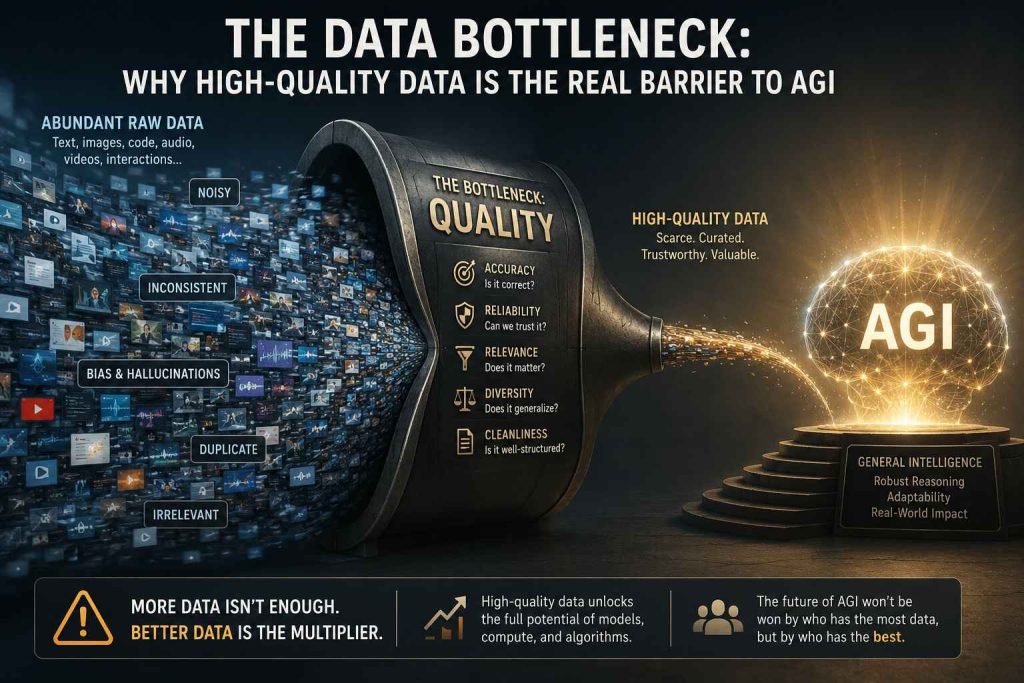
The Data Bottleneck: Why High-Quality Data is the Real Barrier to AGI

For years, the dominant narrative in AI progress has been a story about compute. More GPUs. Bigger clusters. Larger parameter counts. And to be fair, it has worked — extraordinarily well. The models produced by scaling compute over the past decade have surpassed nearly every prediction made about them. But a quieter problem has been

The Data Bottleneck: Why High-Quality Data is the Real Barrier to AGI Read More »

How High-Quality Training Data is Shaping the Next Generation of LLMs

Large Language Models (LLMs) have captured the world’s imagination. From ChatGPT to Gemini, these models can write code, summarize documents, and even reason through complex problems. But beneath the impressive capabilities lies a simple, often overlooked truth: an LLM is only as good as the data it learns from. As the AI industry moves beyond

How High-Quality Training Data is Shaping the Next Generation of LLMs Read More »