
For years, the dominant narrative in AI progress has been a story about compute. More GPUs. Bigger clusters. Larger parameter counts. And to be fair, it has worked — extraordinarily well. The models produced by scaling compute over the past decade have surpassed nearly every prediction made about them.
But a quieter problem has been building in the background. One that more compute cannot solve. One that better architecture alone cannot fix.
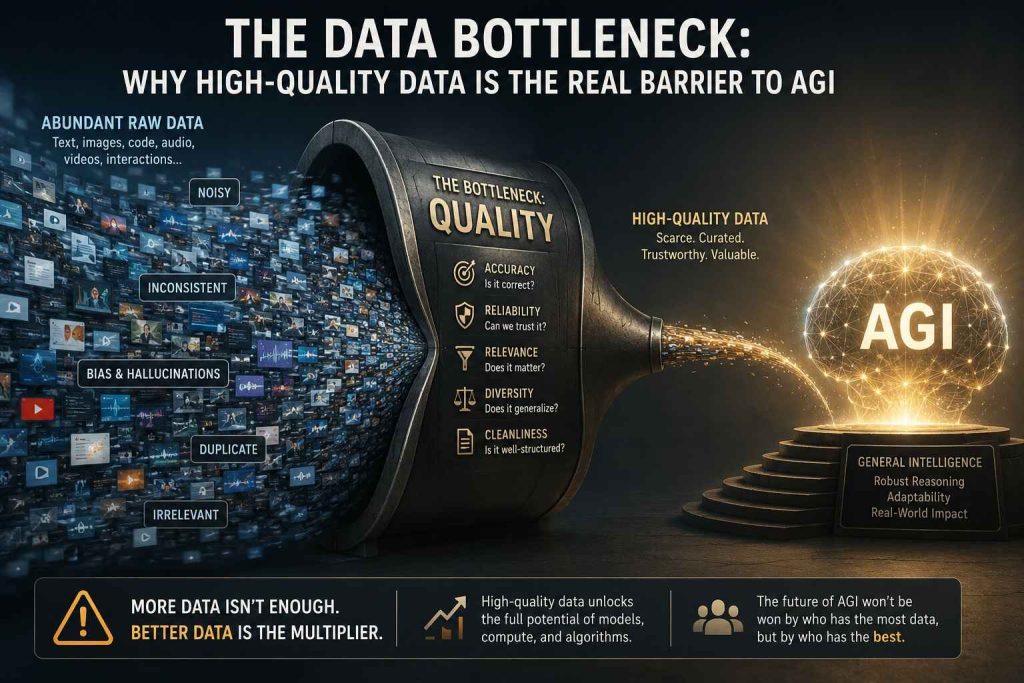
The problem is data. Specifically, the scarcity of data that is high-quality, diverse, accurately labelled, and genuinely representative of the complexity that Artificial General Intelligence would need to navigate.
The path to AGI — however one defines it — runs directly through this bottleneck. And the organisations, researchers, and teams that understand this earliest will shape what the next decade of AI actually looks like.
Central Argument
Compute scaling has driven a decade of AI progress, but the returns are compressing. The frontier of AI capability is now increasingly determined by data — its quality, diversity, structure, and curation. This is the real barrier to AGI, and it is a solvable engineering problem.
1. The Scaling Laws and Their Limits
The 2020 publication of scaling laws by researchers at OpenAI gave the AI field a powerful framework: model performance improves predictably as you scale compute, data, and parameters together. The implication was clear — scale up, and capability follows.
This insight drove an extraordinary period of investment. Models grew from billions to hundreds of billions of parameters. Training runs consumed megawatts of power and months of compute time. And the results were genuinely remarkable — large language models demonstrating reasoning, code generation, multilingual fluency, and creative output that few anticipated.
But the scaling curve is not infinite. Research teams and practitioners have begun observing that returns on compute scaling are compressing. Adding more parameters to models trained on the same data yields diminishing marginal gains. The models are, in a meaningful sense, running out of new things to learn from the data they have.
The Internet Is Not Infinite
The most common source of training data for large foundation models has been the public internet — web crawls, digitised books, code repositories, academic papers, and social media. These sources are vast. But they are not unlimited, and they have been mined aggressively.
Estimates from researchers suggest that high-quality, deduplicated English-language text from the public web may be approaching exhaustion as a training source for frontier models. The data that remains either duplicates what has already been used, is lower quality than what has already been filtered out, or sits behind access restrictions that prevent its use.
More compute applied to a fixed or slowly growing pool of quality data yields diminishing returns. This is the first dimension of the data bottleneck.
Research Signal
Leading AI labs have begun investing heavily in data curation, synthetic data generation, and proprietary data partnerships — a clear signal that the frontier of capability is no longer primarily a compute problem. It is a data problem.
2. Why Quality Matters More Than Volume
The instinct when facing a data shortage is to acquire more data. More web crawl. More synthetic generation. More partnerships. Volume is the intuitive response to scarcity.
But for the capabilities that matter most on the path to AGI, volume without quality is counterproductive. Models trained on large quantities of low-quality data do not just plateau — they acquire systematic errors, biases, and failure modes that are expensive to unlearn.
The Signal-to-Noise Problem
A trillion-token dataset drawn from unfiltered web crawl contains an extraordinary amount of noise: factual errors, self-contradictions, low-quality content, SEO-optimised filler, and text that is technically fluent but epistemically unreliable. A model trained on this data learns to reproduce the patterns of the web — including its errors.
The highest-performing models in recent evaluations are not necessarily those trained on the most data. They are those trained on the most carefully curated data. Filtering, deduplication, quality scoring, and domain balancing have emerged as competitive differentiators between frontier labs — not just the size of the training run.
Reasoning Requires Depth, Not Just Breadth
AGI-adjacent capabilities — complex multi-step reasoning, causal inference, genuine understanding rather than sophisticated pattern matching — appear to require something qualitatively different from breadth of exposure. They require deep, structured, accurate examples of the reasoning processes themselves.
This is why chain-of-thought datasets, expert-annotated reasoning traces, and curated problem-solution pairs have become so valuable. They do not add volume. They add depth — and depth is what the next capability frontier appears to require.
3. The Diversity Deficit
Even high-quality data can fail if it is not sufficiently diverse. And current training datasets — despite their enormous scale — have significant diversity deficits that constrain AGI progress.
Linguistic and Cultural Concentration
Publicly available training data is overwhelmingly concentrated in English. Estimates suggest that English represents a majority of the content in most large web corpora, despite being spoken natively by a small fraction of the world’s population. Models trained on this distribution perform dramatically better in English than in other languages — not because language models are inherently better at English, but because the training signal is so lopsided.
A system with genuine general intelligence would need to demonstrate capability across the full range of human linguistic and cultural expression. Current training data cannot support that. Building it requires deliberate, resource-intensive multilingual data collection and curation.
Domain and Modality Gaps
The knowledge embedded in current training data skews heavily toward what has been written down and published online. Vast domains of human expertise exist primarily as tacit knowledge — in the hands and heads of skilled practitioners rather than in text documents.
Medical imaging interpretation. Mechanical fault diagnosis. Agricultural judgment. Skilled trades. Embodied physical tasks. These domains are either absent from or severely underrepresented in current training data. Any path to general capability must solve the problem of capturing and formalising expertise that has never been structured as training data.
Temporal Imbalance
Training corpora are also temporally skewed. Historical text is overrepresented relative to recent events, simply because more time has elapsed for text about historical periods to accumulate. This creates models with uneven knowledge density across time — highly capable on well-documented historical topics, significantly weaker on recent developments.
The Diversity Challenge
Diversity in training data is not a fairness issue alone — though it is that too. It is a capability issue. A model with systematic blind spots in its training distribution will have systematic blind spots in its outputs. Addressing diversity gaps is a prerequisite for general capability, not an optional ethical enhancement.
4. The Annotation Problem at AGI Scale
By blending hyper-realistic synthetic product generation with rigorous verification layers, Synnth AI allows e-commerce platforms to bypass manual data annotation limits entirely. Retailers can simulate hundreds of thousands of product permutations under infinitely varied lighting conditions, camera positions, and fabric drapes—all pre-labeled with absolute, mathematically pristine ground-truth data. The result is a dramatic acceleration in model accuracy alongside a 70% reduction in classic data preparation lifecycles.
The Road Ahead: Building Resilient AI Ecosystems
Scaling AI toward general capability does not just require more raw data. It requires more labelled data — data where the correct answer, the relevant reasoning, or the appropriate output has been specified by a human or a trusted process.
And this is where the bottleneck becomes acutely visible. Because high-quality annotation does not scale automatically with compute. It scales with people — specifically, with people who have the expertise to label complex, ambiguous, domain-specific examples correctly.
The Expert Annotation Ceiling
For the kinds of data that matter most on the path to AGI — complex reasoning traces, expert domain knowledge, nuanced judgment calls — annotation requires genuine expertise. Medical annotation requires clinicians. Legal annotation requires lawyers. Scientific annotation requires domain researchers.
These individuals exist in limited supply. Their time is expensive. And the annotation tasks required for frontier AI training are not tasks that can be delegated to generalist crowdworkers without significant quality degradation.
This creates a genuine ceiling on the rate at which high-quality labelled training data can be produced. It is a human capital constraint, not a compute constraint.
Instruction Following and Alignment Data
The alignment of powerful AI systems — ensuring they follow instructions accurately, refuse harmful requests appropriately, and behave predictably across diverse inputs — requires its own specialised annotation. Reinforcement learning from human feedback (RLHF) and related techniques depend on human preference data: examples where trained reviewers evaluate and rank model outputs.
Producing this data at the quality and scale required for frontier models is one of the most resource-intensive annotation challenges in the field. And as models become more capable, the bar for the reviewers evaluating them rises correspondingly. You cannot use generalist reviewers to evaluate expert-level model outputs.
5. Synthetic Data: Partial Solution, New Challenges
The most discussed response to the data bottleneck is synthetic data generation — using existing models to produce training data for future, more capable models. This is an active area of research and investment, and it has produced genuine results.
Techniques like self-play, constitutional AI, and model-generated chain-of-thought have demonstrated that carefully designed synthetic data pipelines can improve model capability in specific domains. The intuition is compelling: if a capable model can generate high-quality examples of correct reasoning, those examples can train an even more capable successor.
The Limits of Self-Generated Data
But synthetic data is not a clean solution to the data bottleneck. It introduces its own constraints.
- Models trained primarily on their own outputs tend to converge — losing diversity and developing systematic biases toward their own error modes. Maintaining diversity in synthetic pipelines is a non-trivial engineering challenge. Model collapse risk:
- Synthetic data generated by a model cannot, in general, exceed the capability level of the generating model. It can reorganise and recombine existing knowledge, but it cannot introduce fundamentally new information or correct systematic errors in the base model’s understanding. Quality ceiling:
- For synthetic data to be reliably useful in high-stakes domains, it requires human verification — which reintroduces the expert annotation bottleneck at a different point in the pipeline. Verification requirements:
Synthetic data is a powerful tool for data augmentation, coverage extension, and cost reduction. It is not a replacement for the human-grounded, expert-verified training signal that frontier AI development requires.
6. What Solving the Data Bottleneck Actually Requires
The data bottleneck is not unsolvable. But solving it requires treating data as a first-class engineering and strategic problem — with the same seriousness and investment that has been directed at compute and model architecture.
Proprietary Data Partnerships
The most valuable training data is data that is not publicly available. Expert knowledge in medicine, law, engineering, and science exists in clinical records, case files, technical documentation, and institutional archives. Accessing it requires structured partnerships, licensing agreements, and privacy-preserving processing pipelines. The labs and organisations that establish these partnerships earliest have a durable competitive advantage.
Specialised Annotation Infrastructure
Building reliable pipelines for expert-level annotation — not just at project scale but continuously, as a core operational capability — is a differentiating investment. This means sourcing and retaining domain expert annotators, building tooling that makes complex annotation tractable, and maintaining quality systems that catch errors before they reach training pipelines.
Data Curation as a Discipline
Curation — the process of selecting, filtering, deduplicating, and balancing training data — is increasingly recognised as a core technical discipline, not a preprocessing step. Organisations that invest in curation tooling, curation research, and dedicated curation teams will produce better models from equivalent data volumes than those that treat curation as a commodity task.
Feedback Loops from Deployment
Production AI systems generate valuable training signal. Every interaction, every correction, every failure mode encountered in deployment is an opportunity to identify gaps in training coverage and produce targeted new data. Building the infrastructure to capture, filter, and route this signal back into training pipelines is one of the highest-leverage data investments an AI organisation can make.
Synnth.ai Perspective
At Synnth.ai, we work at exactly this intersection — between the data that exists and the data that frontier AI systems need. The gap is real, it is large, and it is where the most important work in AI development is happening right now. The organisations that treat data as a strategic capability — not a commodity input — will define what AI looks like at the next capability level.
Conclusion: The Next Frontier Is a Data Problem
AGI remains a contested concept — debated in its definition, its timeline, and its implications. But one thing is increasingly clear across the research community: whatever form advanced AI capability takes next, it will require better data than we currently have.
Not just more of it. Better. More diverse. More accurately labelled. More carefully curated. More representative of the full range of human knowledge and judgment — including the vast domains that have never been structured as training data.
Compute scaling opened a decade of progress. Data quality will define the next one. The data bottleneck is the most important unsolved engineering problem on the path to advanced AI — and it is waiting for the organisations, researchers, and teams willing to treat it as such.
Partner with Synnth.ai
Synnth.ai helps AI teams design and scale the data infrastructure required for frontier model development — from expert annotation pipelines and curation tooling to synthetic data strategy and proprietary data partnerships. If data quality is your bottleneck, we should talk.