
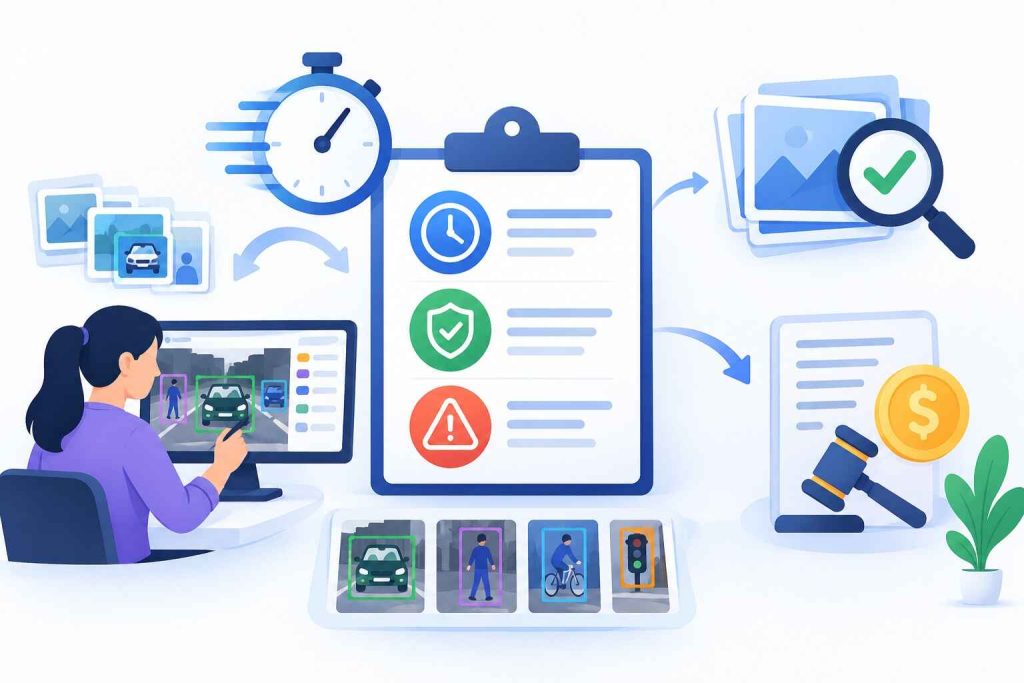
| You have found an annotation vendor, agreed on pricing, and kicked off your ML project. Three weeks later, you receive a dataset that is 40% over the agreed delivery date, riddled with labeling inconsistencies, and missing the quality report that was supposed to accompany it. When you raise the issue, the vendor shrugs — there was no binding agreement on any of it. This scenario plays out more often than most AI product teams would like to admit. And in almost every case, the root cause is the same: the annotation contract had no enforceable Service Level Agreement (SLA). A well-constructed annotation SLA is not a bureaucratic formality. It is a risk management instrument — one that defines what your vendor is committing to, how performance will be measured, what happens when they fall short, and how disputes get resolved. Done right, it transforms an ambiguous vendor relationship into an accountable one. This guide breaks down every component of a robust data annotation SLA: turnaround time benchmarks, quality guarantee standards, penalty structures, escalation clauses, and the red flags that signal a vendor is not equipped to honor their commitments. |
Who This Guide Is For
ML engineers, AI product managers, and procurement leads who are evaluating annotation vendors, negotiating annotation contracts, or reviewing existing vendor relationships for SLA gaps.
1. What Is a Data Annotation SLA?
A Service Level Agreement (SLA) is a formal, contractual commitment from an annotation vendor specifying the measurable standards they will meet for your project. Unlike general contract terms — which define scope, pricing, and ownership — an SLA defines performance: how fast, how accurate, how consistently, and with what consequences if those standards are not met.
For data annotation specifically, an SLA typically covers four domains:
- Turnaround time — When will annotated data be delivered, and in what batches?
- Annotation quality — What accuracy, consistency, and completeness standards will be met?
- Process compliance — What QA processes, tooling, and staffing commitments underpin the quality guarantee?
- Remediation and penalties — What happens when SLA terms are missed, and who pays for it?
According to the IT Infrastructure Library (ITIL) framework — widely adopted for service management across industries — an effective SLA must be specific, measurable, achievable, relevant, and time-bound. These same principles apply directly to annotation vendor agreements.
For a broader reference on SLA construction principles, the ISO/IEC 20000 Service Management Standard [https://www.iso.org/standard/70636.html] provides the authoritative framework used by enterprise service vendors globally.
2. Turnaround Time SLAs: What to Expect and What to Demand
Turnaround time is the most commonly negotiated and most commonly violated SLA component in annotation contracts. Teams often accept vague delivery language (‘approximately 2–3 weeks’) without recognizing that this provides zero contractual protection.
2.1 How Turnaround Time Should Be Defined
A precise turnaround time SLA specifies all of the following:
- Start date: When the clock begins — typically upon receipt of raw data and acceptance of the annotation brief, not upon contract signature.
- Batch structure: Whether delivery is phased (e.g., 20% of dataset per week) or all-at-once, and the specific date for each batch.
- Delivery format: The file format, directory structure, and metadata schema in which annotated data will be delivered.
- Review cycle time: How quickly the vendor will respond to quality revision requests — typically 24–72 hours for minor corrections, 5–10 business days for significant rework.
- Force majeure carve-outs: Explicit definition of what constitutes an acceptable delay versus what does not (internal staffing shortages, annotator attrition are not acceptable).
2.2 Benchmark Turnaround Times by Project Type (2026)
The following benchmarks reflect realistic turnaround times for professionally managed annotation at typical volumes. Use these as reference points when evaluating vendor proposals — commitments significantly outside these ranges warrant scrutiny in either direction.
| Task Type | Small (<5K items) | Medium (5K–50K) | Large (50K–500K) | Continuous Pipeline |
| Image classification | 2–4 days | 1–2 weeks | 3–6 weeks | 48–72 hr/batch |
| Bounding box detection | 3–5 days | 2–3 weeks | 5–8 weeks | 72–96 hr/batch |
| Semantic segmentation | 5–10 days | 3–5 weeks | 8–14 weeks | 5–7 days/batch |
| Text / NER annotation | 2–4 days | 1–2 weeks | 3–5 weeks | 24–48 hr/batch |
| Audio transcription | 3–6 days | 2–4 weeks | 6–10 weeks | 48–72 hr/batch |
| RLHF preference ranking | 5–7 days | 2–4 weeks | 8–12 weeks | 72–96 hr/batch |
| Medical / specialist annotation | 7–14 days | 4–8 weeks | 12–20 weeks | 5–10 days/batch |
| Red FlagAny vendor promising turnaround times significantly faster than these benchmarks for complex tasks — without a specific explanation of staffing capacity — is likely overpromising. Speed commitments must be grounded in annotator capacity, not sales optimism. |
2.3 Rush Delivery and Priority Queues
Most professional annotation vendors offer expedited delivery tiers for projects with tight model training timelines. Rush delivery — typically 30–50% faster than standard turnaround — carries a price premium of 25–75% on base annotation costs. Negotiate rush pricing and trigger conditions into your SLA upfront rather than discovering them mid-project when your leverage is lowest.
The Project Management Institute’s PMBOK Guide [https://www.pmi.org/pmbok-guide-standards] recommends scheduling buffer time equal to 15–20% of total project duration as standard risk management practice — a principle that applies directly to annotation project timelines.
3. QA Guarantees: Defining and Measuring Annotation Quality
Quality guarantees are the most complex and most consequential component of an annotation SLA. They are also the most commonly underspecified — vendors frequently offer headline accuracy figures (‘98% accuracy guaranteed’) without defining how accuracy is measured, on what sample, by what method, or against what ground truth.
3.1 The Four Dimensions of Annotation Quality
- Accuracy: What percentage of annotations match the gold-standard ground truth? Requires careful definition — accuracy on what task, measured on what sample size, validated by whom?
- Consistency: When the same data item is annotated by multiple annotators, do they agree? Measured via inter-annotator agreement (IAA) — Cohen’s Kappa for two annotators, Fleiss’ Kappa for multiple.
- Completeness: What percentage of items in the delivered dataset are annotated? A dataset that is 95% complete is not a complete dataset.
- Schema compliance: Do all annotations conform to the specified schema — correct label taxonomy, required metadata fields populated, correct file format and naming conventions?
3.2 Quality Benchmark Standards by Task Type
| Task Type | Min. Accuracy | Min. IAA (Kappa) | Notes |
| Image classification | 95% | ≥ 0.80 | Higher for safety-critical applications |
| Object detection (bounding box) | 92% | ≥ 0.75 | IoU threshold ≥ 0.70 recommended |
| Semantic segmentation | 90% | ≥ 0.72 | Pixel-level IoU; task-dependent |
| NER / text annotation | 94% | ≥ 0.78 | Entity boundary accuracy matters |
| Audio transcription | WER < 5% | ≥ 0.82 | Clean audio; higher WER tolerance for noise |
| RLHF preference ranking | N/A | ≥ 0.75 | IAA is primary metric |
| Medical annotation | 97%+ | ≥ 0.85 | Expert review required for adjudication |
For authoritative guidance on IAA metrics and their interpretation, refer to Artstein & Poesio (2008) in Computational Linguistics (MIT Press) [https://direct.mit.edu/coli/article/34/4/555/1999/Inter-Coder-Agreement-for-Computational-Linguistics] — the definitive academic reference on inter-annotator agreement.
3.3 How QA Guarantees Should Be Operationalized in Your SLA
A quality guarantee is only as strong as its operational definition. A well-constructed QA SLA specifies:
- Sample size for QA audit — Minimum percentage of each delivered batch subject to QA review (typically 10–20% for standard projects, 100% double-annotation for high-stakes projects).
- QA methodology — Who conducts the review, using what tools, against what gold-standard reference.
- Measurement frequency — QA metrics reported per-batch, not just at project completion.
- Dispute resolution for QA disagreements — Escalation path when client QA check disagrees with vendor’s reported accuracy.
- Definition of ‘passing’ quality — Minimum acceptable score at the batch and project level, separately defined.
4. Penalty Structures: What Happens When SLAs Are Missed
| An SLA without a penalty structure is a wish list. Enforceable annotation SLAs include specific, proportionate consequences for non-performance — consequences that create genuine accountability without making the vendor relationship adversarial. |
4.1 Types of SLA Penalties
- Service credits: When SLA terms are missed, the vendor issues a credit against future invoices — typically a percentage of the affected batch or project value.
- Fee abatement: A direct reduction in the current invoice amount for the period in which SLA terms were missed. Stronger than service credits.
- Rework at no charge: The vendor re-annotates items that fail quality standards at their own cost, within a specified timeframe. This is a baseline expectation in any annotation SLA.
- Termination for cause: Persistent, material SLA violations give the client the right to terminate the contract without penalty. Thresholds should be defined specifically.
- Liquidated damages: For projects where annotation delays have quantifiable downstream consequences, a fixed compensation amount per day of delay. Should reflect genuine loss estimates, not punitive amounts.
4.2 Penalty Benchmarks: What Is Reasonable
| SLA Violation | Service Credit | Fee Abatement | Termination Threshold |
| Delivery 1–5 days late | 3–5% of batch value | Not typical | Not triggered |
| Delivery 6–14 days late | 8–15% of batch value | 5–10% of batch value | Not typical |
| Delivery 15+ days late | 15–25% of project value | 10–20% of project value | Often triggered |
| Quality below threshold (single batch) | 5–10% of batch value | Rework at no charge | Not triggered |
| Quality below threshold (repeated) | 10–20% of project value | 10–15% of project value | Often triggered |
| Completeness below 98% | Prorated for missing items | Prorated + rework | If >5% missing, often triggered |
| Data security breach | N/A | Full project value | Immediate termination |
| Legal NoteSLA penalty clauses should be reviewed by legal counsel before execution. In most common law jurisdictions (US, UK, Australia), penalty clauses exceeding genuine pre-estimated losses may be unenforceable. Structure penalties as genuine loss estimates, not deterrents. |
5. Escalation and Remediation Clauses
Beyond penalty structures, a well-constructed annotation SLA defines what happens operationally when issues arise — before they become disputes.
5.1 Issue Escalation Path
Your SLA should specify a tiered escalation process:
- Tier 1 — Operational issue: Reported to dedicated project manager. Response time: 4–8 business hours. Resolution target: 2–3 business days.
- Tier 2 — Quality escalation: Escalated to vendor QA lead and client ML lead jointly. Response: same business day. Resolution: 5–7 business days.
- Tier 3 — Material breach: Escalated to vendor account director and client procurement/legal. Formal cure period begins (typically 10–14 calendar days).
- Tier 4 — Unresolved breach: Termination for cause trigger, third-party arbitration, or escalated remediation negotiation.
5.2 Cure Period
A cure period is the time a vendor has to remediate an SLA breach before penalties escalate or termination rights are triggered. Standard cure periods for annotation SLAs are 10–14 calendar days for quality breaches and 7 calendar days for delivery breaches. The SLA should specify what measurable standard constitutes successful remediation.
5.3 Root Cause Analysis (RCA) Requirements
For significant quality failures, your SLA should require the vendor to deliver a written root cause analysis within 5–7 business days — identifying what caused the failure, what process changes will prevent recurrence, and what monitoring will be in place going forward.
The IEEE’s Software Quality Assurance standard (IEEE 730) [https://standards.ieee.org/ieee/730/] provides a structured framework for quality assurance process requirements applicable to AI data services.
6. Data Security and Compliance SLA Components
For AI product teams in healthcare, finance, legal, and government — data security is a regulatory requirement that must be codified in the SLA.
6.1 Security Commitments to Include
- Data handling protocol: Transmission, storage, access, and deletion procedures. Specify encryption standards (AES-256 at rest, TLS 1.2+ in transit as minimum baseline).
- Access control: Role-based access controls, audit logs of all data access, and background check requirements for annotators handling sensitive data.
- Data residency: Where data will be processed and stored — critical for teams subject to GDPR or India’s DPDP Act.
- Breach notification: 72 hours is the GDPR standard; many enterprise SLAs specify 24 hours for material incidents.
- Anonymization and PII handling: Anonymization procedures and prohibition on vendor use of client data for their own model training.
- Right to audit: Client retains right to audit vendor security practices, directly or through a third-party auditor, with reasonable notice.
For annotation projects subject to HIPAA, refer to the HHS HIPAA Security Rule guidance [https://www.hhs.gov/hipaa/for-professionals/security/index.html] for the minimum technical safeguard requirements your vendor agreement must address.
7. Red Flags in Annotation Vendor SLA Proposals
These are the warning signs that a vendor’s SLA proposal does not reflect genuine operational capability:
Red Flag 1: Vague Quality Metrics
Any SLA that promises ‘high accuracy’ or ‘98% quality’ without specifying the measurement methodology, sample size, task definition, or adjudication process is meaningless as a contractual commitment. Push for specificity: accuracy measured how, on what sample, compared to what ground truth, validated by whom.
Red Flag 2: No IAA Reporting
A vendor who does not report inter-annotator agreement either does not measure it or does not want you to see it. IAA is the most reliable indicator of annotation consistency and guideline quality. Its absence from QA reporting is a significant warning sign.
Red Flag 3: One-Size-Fits-All Turnaround Commitments
A vendor offering identical turnaround guarantees for image classification and medical image segmentation is not calibrating their commitments to task reality. Uniform commitments across task types suggest the vendor has not thought carefully about delivery capacity.
Red Flag 4: No Rework Obligation
Any vendor who does not include a no-charge rework commitment for annotations that fail quality review is asking you to absorb the cost of their quality failures. This is non-negotiable.
Red Flag 5: Penalties Capped Below Project Value
Some vendors cap total SLA penalties at 10–15% of project value regardless of breach severity. This means a vendor can miss every deadline and quality target and pay a maximum penalty of 15% — while you absorb the full downstream cost of model retraining and rework. Negotiate uncapped or higher-ceiling penalties for material breaches.
Red Flag 6: No Third-Party Security Certification
For vendors handling sensitive or regulated data, SOC 2 Type II certification (or ISO 27001 for international vendors) is the minimum acceptable evidence of security program maturity.
For reference, the AICPA SOC 2 Framework [https://www.aicpa-cima.com/resources/landing/soc-2-report] defines the trust service criteria against which SOC 2 audits are conducted — request current certification from any vendor handling sensitive training data.
8. The Complete Annotation SLA Checklist
Use this checklist when reviewing a vendor’s proposed SLA or drafting your own requirements:
Turnaround Time
- Start date defined (raw data receipt + brief acceptance)
- Batch delivery schedule specified with exact dates
- Delivery format and schema specified
- Revision response time commitment (24–72 hours for corrections)
- Rush delivery tier pricing and triggers negotiated
- Force majeure carve-outs specifically defined
Quality Guarantees
- Accuracy target defined with measurement methodology
- IAA target specified (Cohen’s/Fleiss’ Kappa threshold)
- Completeness requirement stated (minimum 98–99% recommended)
- Schema compliance requirement included
- QA sample size specified (minimum 10% per batch)
- QA methodology described (blind review, gold-standard comparison)
- Per-batch quality reporting commitment
- Dispute resolution process for QA disagreements
Penalties and Remediation
- Service credit schedule for delivery delays
- Fee abatement provisions for significant delays
- No-charge rework commitment for below-threshold quality
- Termination-for-cause triggers defined with specific thresholds
- Cure period specified (10–14 days recommended)
- Root cause analysis requirement for material quality failures
- Escalation path (Tier 1 through Tier 4) documented
Security and Compliance
- Data encryption standards specified (AES-256 / TLS 1.2+)
- Access control and audit log requirements
- Data residency commitments (if required by regulation)
- Breach notification timeline (72 hours maximum)
- PII handling and anonymization procedures
- Prohibition on vendor use of client data for own model training
- Right to audit security practices retained
- SOC 2 Type II or ISO 27001 certification required
How Synnth.ai Approaches SLA Commitments
At Synnth.ai, our annotation contracts are built around the SLA components outlined in this guide — because we believe accountability is the foundation of a productive vendor relationship.
- Defined turnaround time commitments per task type and volume tier, with batch-level delivery schedules rather than project-level estimates.
- Accuracy and IAA guarantees specified per task — operationally defined commitments with measurement methodology documented.
- Per-batch QA reporting delivered alongside every annotation batch, including IAA scores, accuracy against gold standard, and completeness metrics.
- No-charge rework for any annotation batch that fails to meet agreed quality thresholds — always, without dispute.
- Tiered penalty structure including service credits, fee abatement, and termination-for-cause provisions calibrated to breach severity.
- SOC 2 Type II aligned data handling with role-based access controls, full audit logs, and breach notification within 24 hours.
- Dedicated project manager for every client, with defined escalation paths and response time commitments at each tier.
We publish our standard SLA terms as part of our vendor onboarding process and welcome client-specific customization for security, quality, and delivery requirements.
Frequently Asked Questions (FAQs)
Q1. Is a data annotation SLA legally enforceable?
Yes, provided it is incorporated into a signed contract (Master Service Agreement or Statement of Work) with adequate specificity. Vague SLA language — ‘high quality,’ ‘reasonable turnaround’ — is difficult to enforce because it lacks an objective standard. SLAs with specific, measurable thresholds, defined measurement methodologies, and explicit penalty structures are enforceable in most jurisdictions. Always have contracts reviewed by legal counsel before execution.
Q2. What is a reasonable accuracy guarantee for data annotation?
It depends on the task. For standard image classification and text annotation, 94–96% accuracy is a reasonable baseline. For medical, legal, or safety-critical annotation, 97–99%+ with expert adjudication is appropriate. The more important question is how accuracy is measured — a vendor claiming 98% accuracy on their own internal QA sample is a much weaker guarantee than 98% accuracy measured via blind double-annotation against a client-defined gold standard.
Q3. How do I measure inter-annotator agreement for my annotation project?
For categorical annotation tasks (classification, NER, sentiment), use Cohen’s Kappa for two annotators or Fleiss’ Kappa for multiple annotators. For bounding box and segmentation tasks, use Intersection over Union (IoU) averaged across annotator pairs. For transcription, use Word Error Rate (WER) between annotators.
scikit-learn’s documentation on Cohen’s Kappa [https://scikit-learn.org/stable/modules/model_evaluation.html#cohen-s-kappa] provides a clear technical reference for the metric and its interpretation.
Q4. Can I negotiate SLA terms with a smaller annotation vendor?
Yes — and you should. SLA negotiation is not limited to enterprise contracts. Even with smaller vendors, negotiate: delivery dates (not ‘approximately’), accuracy minimums, no-charge rework commitments, and data security provisions. The vendor may not have a standard SLA template — in that case, provide your own. A vendor who refuses to commit to any measurable quality or delivery standard is telling you something important about how they operate.
Q5. What should I do if a vendor misses their SLA commitments?
Follow the escalation path defined in your SLA. Document the breach in writing, reference the specific SLA clause that was missed, and trigger the applicable cure period. Maintain a log of all SLA events, communications, and remediation actions. If the breach is material and the vendor fails to cure within the defined period, your termination-for-cause clause gives you the right to exit the contract.
Q6. How often should annotation SLAs be reviewed and updated?
At minimum, annotation SLAs should be reviewed at the start of each new project phase and renegotiated annually for ongoing partnerships. As your model matures, your quality requirements may change — early-stage model training may tolerate 90% annotation accuracy, while a production-critical model may require 97%+. Build scheduled SLA review checkpoints into your vendor relationship from the start.
Q7. What is the difference between an SLA and a KPI in annotation contracts?
An SLA is a contractual commitment with defined consequences for non-performance. A KPI (Key Performance Indicator) is a measurement used to track operational performance — it may or may not have contractual teeth. Many vendor contracts track annotation KPIs without committing to penalty consequences when they are missed. For genuine accountability, you need SLA terms with penalty provisions, not just KPI dashboards.
Conclusion
A data annotation SLA is not red tape. For AI product teams whose model performance depends on the quality and reliability of their training data, it is one of the most important risk management documents in their vendor portfolio.
The cost of a poorly constructed annotation SLA is not measured in the cost of the SLA itself — it is measured in annotation rework, model retraining cycles, delayed product launches, and the downstream consequences of shipping AI trained on inconsistent data.
The framework in this guide gives you everything you need to negotiate annotation SLAs that protect your project: turnaround benchmarks grounded in operational reality, quality metrics that are specific and measurable, penalty structures that create genuine accountability, and security provisions that protect sensitive data.
Demand these standards from your annotation vendors. The ones who can meet them will welcome the specificity — because it is the same specificity they use to manage their own operations.
Ready to see Synnth.ai’s SLA terms in detail? Visit synnth.ai to request our vendor onboarding pack.
Related Articles from Synnth.ai
Deepen your understanding of data annotation strategy, quality, and budgeting with these related guides:
→ What Is Data Annotation? The Complete Guide for AI Product Teams in 2026
A comprehensive introduction to data annotation — types, methodologies, workflows, and quality metrics — written specifically for AI product teams building and shipping ML systems.
→ Data Labeling Cost Calculator: Budgeting for Your Next ML Project
Benchmark pricing by task type, a step-by-step annotation budget calculator, hidden cost breakdowns, and three real-world budget scenarios to help you plan your annotation spend accurately.
→ Top 5 Mistakes in Audio Transcription for AI Training (and How to Fix Them)
The five most consequential audio annotation errors — disfluency handling, speaker diarization, quality tagging, paralinguistic data, and QA processes — with actionable fixes for each.
Sources & Further Reading
The following authoritative sources were referenced in the preparation of this article:
ISO/IEC 20000-1: IT Service Management Standard — https://www.iso.org/standard/70636.html
The international standard defining IT service management best practices, including SLA construction principles applicable to annotation and AI data services.
AICPA SOC 2 Trust Services Criteria — https://www.aicpa-cima.com/resources/landing/soc-2-report
The authoritative framework for evaluating data security, availability, and integrity controls in service organizations — the standard against which annotation vendors should be audited.
Project Management Institute: PMBOK Guide — https://www.pmi.org/pmbok-guide-standards
The global standard for project planning, scheduling, and risk management — referenced for timeline buffer recommendations applicable to annotation project planning.
IEEE 730: Software Quality Assurance Standard — https://standards.ieee.org/ieee/730/
IEEE standard for software quality assurance processes, applicable to AI and annotation pipeline quality governance requirements.
Artstein & Poesio (2008): Inter-Coder Agreement for Computational Linguistics — https://direct.mit.edu/coli/article/34/4/555/1999/Inter-Coder-Agreement-for-Computational-Linguistics
The definitive academic reference on inter-annotator agreement metrics for NLP annotation — basis for IAA benchmarks cited in this article.
HHS HIPAA Security Rule Guidance — https://www.hhs.gov/hipaa/for-professionals/security/index.html
U.S. Department of Health & Human Services guidance on HIPAA Security Rule requirements — mandatory reference for annotation SLAs involving health data.
scikit-learn: Cohen’s Kappa Metric Documentation — https://scikit-learn.org/stable/modules/model_evaluation.html#cohen-s-kappa
Technical documentation and interpretation guide for Cohen’s Kappa inter-annotator agreement metric, with implementation examples.