
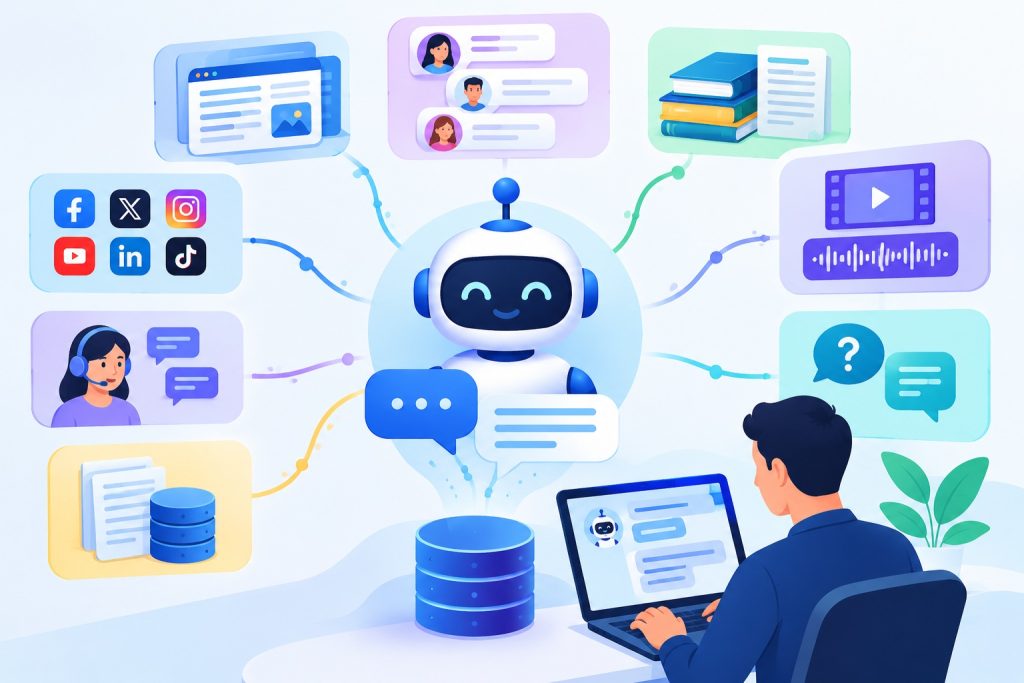
| are plentiful — truly useful dialogue data is harder to find, harder to collect, harder to annotate, and harder to evaluate. Public datasets are often too generic, too narrow, or too old. Synthetic data is promising but carries distributional risks. Internal production logs are potentially rich but almost always require significant cleaning and annotation before they are training-ready. This guide gives AI product teams and ML engineers a complete, opinionated map of the conversational training data landscape in 2026: where to find it, how to evaluate it, how to generate it, and how to annotate it for production-quality dialogue AI. What This Guide Covers Open-source conversational datasets | Synthetic data generation | Human-generated data collection | Production data pipelines | Domain-specific data strategies | Annotation requirements for dialogue data | Data quality evaluation framework | FAQs |
1. Why Conversational AI Training Data Is Uniquely Challenging
Before diving into sources, it is worth understanding what makes dialogue data structurally different from other training data types — because these differences shape every sourcing and annotation decision you will make.
1.1 Conversational Context Is Multi-Turn and Sequential
A single utterance in a conversation carries meaning only in the context of what came before it. ‘Yes, that works for me’ means nothing without the preceding exchange. This means conversational training data cannot be treated as independent samples — the full conversational context must be preserved, annotated, and modelled. Most general-purpose NLP datasets do not have this property.
1.2 Real Conversations Are Messy and Varied
Human dialogue includes interruptions, topic switches, implicit references, disfluencies, sarcasm, ellipsis, and language that assumes shared context. Cleaned or scripted dialogue — the kind that appears in many public datasets — strips out this richness and produces models that perform well on benchmarks but poorly on real user interactions. Training data must reflect the actual distribution of conversations your model will encounter.
1.3 Intent and Entity Coverage Must Be Comprehensive
For task-oriented chatbots, your training data must cover every intent your model is expected to handle — including edge cases, reformulations, and negative examples (things users say that look like an intent but are not). Gaps in intent coverage produce models with hard failure modes that erode user trust rapidly.
1.4 Conversational AI Data Has a Short Shelf Life
Language evolves, product features change, user expectations shift. A conversational dataset that was production-quality 18 months ago may produce a model that feels dated, misses new intents, or references deprecated features. Continuous data collection and annotation is not a luxury for conversational AI teams — it is a maintenance requirement.
For a rigorous technical treatment of the challenges in dialogue modelling, the ACL Anthology — Advances in Dialog Systems [aclanthology.org] is the primary academic repository for peer-reviewed dialogue NLP research, covering dataset construction, evaluation, and modelling from leading institutions worldwide.
2. Source 1: Open-Source Conversational Datasets
Open-source datasets are the fastest way to bootstrap a conversational AI project. They are free, immediately available, and often accompanied by baseline model benchmarks. Their limitations — domain mismatch, temporal staleness, licensing restrictions, and coverage gaps — mean they are almost always a starting point, not a complete solution.
Here are the most useful open-source conversational datasets for AI product teams in 2026, organized by use case:
2.1 General-Purpose Dialogue Datasets
| Dataset | Size | License | Best For |
| DailyDialog | 13K dialogues | CC BY-NC-SA | Everyday conversation; sentiment & act labels |
| OpenSubtitles | 400M+ sentences | CC BY | Large-scale pre-training; multilingual |
| ConvAI2 (PersonaChat) | 162K utterances | CC BY | Persona-grounded dialogue |
| BlendedSkillTalk | 7K dialogues | CC BY | Empathy, knowledge, persona blending |
| SODA | 1.5M dialogues | CC BY | Diverse social conversation; commonsense grounded |
| Wizard of Wikipedia | 22K dialogues | CC BY | Knowledge-grounded conversation |
| Hugging Face Datasets Hub https://huggingface.co/datasets The largest centralized repository of open NLP and dialogue datasets — searchable by task, language, and license. Essential first stop for any conversational AI dataset search |
2.2 Task-Oriented Dialogue Datasets
Task-oriented datasets are critical for chatbots that help users accomplish specific goals — booking, ordering, troubleshooting, Q&A.
| Dataset | Size | License | Best For |
| MultiWOZ 2.4 | 10K dialogues | Apache 2.0 | Multi-domain task: hotel, taxi, restaurant, train, attraction |
| SGD (Schema-Guided Dialogue) | 22K dialogues | CC BY-SA | Zero-shot generalisation across services |
| ATIS | 5K utterances | Public domain | Airline travel intent and slot filling |
| SNIPS NLU | 14K utterances | MIT | Smart assistant intents; intent classification + NER |
| BiTOD | 9.5K dialogues | MIT | Bilingual (English + Chinese) task-oriented dialogue |
| Google Research: Schema-Guided Dialogue Dataset https://github.com/google-research-datasets/dstc8-schema-guided-dialogue Google’s SGD dataset — one of the most comprehensive multi-domain task-oriented dialogue resources available, with structured schema annotations. |
2.3 Customer Service and Support Dialogue Datasets
- Ubuntu Dialogue Corpus — 930K multi-turn dialogues from Ubuntu IRC channels. Technical support context; large scale.
- Twitter Customer Support Dataset (Kaggle) — Real customer service conversations from major brands on Twitter. Useful for informal, short-form support dialogue.
- Zendesk Community datasets — Periodically released support conversation samples; check licensing before use.
2.4 Open-Source Dataset Limitations to Understand
Critical Caveat
Open-source datasets are a starting point, not a production solution. The most important question about any public dataset is: does its conversational distribution match the actual conversations your users will have with your product? Domain mismatch between training data and production traffic is one of the most common causes of chatbot performance failure. Always validate dataset relevance with production data before committing to it as a primary training source.
3. Source 2: Synthetic Conversational Data Generation
Synthetic data generation has become one of the most powerful tools available to conversational AI teams in 2026, driven by the quality and controllability of modern large language models. Instead of waiting for real conversation data, teams can generate it — conditioning on specific personas, intents, topics, tones, and scenarios.
3.1 What Synthetic Dialogue Data Is Good For
- Bootstrapping intent coverage for new product areas where no real conversation data yet exists.
- Augmenting sparse categories — intents or scenarios that appear rarely in real data but must be handled reliably.
- Generating diverse reformulations of the same intent to improve model robustness.
- Creating adversarial examples — inputs designed to challenge the model — for safety testing.
- Filling demographic or linguistic diversity gaps in real datasets.
- Rapid prototyping: generating a seed dataset to train a baseline model before real production data is available.
3.2 Approaches to Synthetic Dialogue Generation
There are three main approaches to generating synthetic conversational training data:
- LLM-prompted generation: Prompting a capable foundation model (e.g., GPT-4 class, Claude, Gemini) to generate dialogues given a persona, intent, scenario, or product description. This is the fastest approach and produces natural-sounding dialogue, but requires careful prompt engineering and quality validation to avoid distributional artifacts.
- Template-based generation: Using structured templates with variable slot-filling to generate large volumes of intent-specific utterances. Less natural than LLM generation but highly controllable and reproducible — useful for slot-filling and intent classification training data.
- Dialogue simulation: Simulating multi-turn dialogues using two LLM agents taking opposite roles (user simulator + agent). More expensive but produces realistic multi-turn context that single-turn generation cannot.
Anthropic’s research on Constitutional AI and RLAIF [https://www.anthropic.com/research/constitutional-ai-harmlessness-from-ai-feedback] demonstrates how AI-generated feedback data can be used to train aligned conversational models — a foundational reference for teams building synthetic RLHF pipelines.
3.3 Quality Risks in Synthetic Data
Synthetic data is not risk-free. The key failure modes to monitor and mitigate:
- Distribution collapse: LLMs tend to generate “average” language — grammatically correct, politely phrased, and covering common scenarios well. They systematically underrepresent edge cases, unusual phrasing, non-native speaker patterns, and informal registers that real users produce.
- Factual hallucination: Synthetically generated product or domain knowledge may contain plausible-sounding errors. Any synthetic data containing factual claims about your product must be validated against a ground-truth source before training.
- Style contamination: If you train on synthetic data generated by a specific LLM and then fine-tune that same LLM family, you risk reinforcing the LLM’s own stylistic biases rather than learning from diverse human expression.
- Over-representation of prompted scenarios: Synthetic datasets reflect the scenarios you thought to prompt for. Gaps in your prompting strategy become gaps in your model’s coverage.
| The 70/30 Rule of Thumb Many experienced conversational AI teams use synthetic data as up to 30% of their fine-tuning mix, with the remaining 70% drawn from real or human-generated data. The optimal ratio varies by task and domain, but treating synthetic data as the primary source without real-world validation is a risk that frequently shows up in production performance. |
4. Source 3: Human-Generated Conversational Data
Human-generated conversational data — produced by trained annotators following structured guidelines — is the gold standard for production-quality conversational AI training. It is more expensive and slower to produce than synthetic data, but it provides the diversity, naturalness, and domain specificity that neither open-source datasets nor synthetic generation reliably deliver.
4.1 Wizard-of-Oz (WOZ) Data Collection
The Wizard-of-Oz methodology is the most established approach to collecting task-oriented dialogue data. A human “wizard” plays the role of the AI system, responding to real user inputs as the system should — before the system exists. This generates high-quality, realistic dialogue data grounded in actual user intent patterns, without the limitations of scripted conversation.
WOZ collection is particularly valuable for:
- Discovering intent and language patterns your system design did not anticipate.
- Generating natural multi-turn context for complex, multi-step tasks.
- Validating that your task design is achievable — if wizards struggle, your model will too.
The original Wizard-of-Oz methodology for dialogue data collection is described in detail in Kelley (1984) in ACM SIGCHI Bulletin [https://dl.acm.org/doi/10.1145/1455741.1455746] — the foundational paper establishing the technique that remains the basis for modern task-oriented dialogue dataset construction.
4.2 Crowdsourced Dialogue Data Collection
Platforms like Amazon Mechanical Turk, Prolific, and specialist annotation vendors can engage large pools of workers to generate or annotate conversational data at scale. Crowdsourced dialogue collection works well for:
- Open-domain chitchat and social conversation datasets where diversity of expression is more important than domain expertise.
- Persona-grounded dialogue collection — assigning workers specific personas and conversation goals.
- Paraphrase generation — having workers rewrite existing utterances in multiple natural ways to improve intent coverage.
- Adversarial data collection — tasking workers to deliberately try to confuse or break the system.
For domain-specific content (medical, legal, technical), crowdsourced collection typically needs to be restricted to workers with verified domain knowledge, which significantly narrows the available pool and raises costs.
4.3 Expert-Written Dialogue Data
For high-stakes conversational applications — medical triage assistants, legal information chatbots, financial advisory tools — dialogue data must be written or validated by domain experts. Expert-written data provides:
- Factual accuracy that cannot be achieved through crowdsourcing or synthetic generation.
- Appropriate tone, terminology, and risk calibration for sensitive domains.
- Regulatory compliance for AI systems subject to industry-specific rules (HIPAA, FCA, etc.).
Expert-written dialogue data is expensive — typically $5–$20 per dialogue turn depending on the domain and expert level — but for safety-critical applications it is not optional.
4.4 Instruction-Response Pair Collection for LLM Fine-Tuning
Teams fine-tuning large language models for conversational tasks increasingly collect structured instruction-response pairs rather than full dialogue transcripts. These pairs train the model on what a high-quality response looks like given a specific user request — the core data format for supervised fine-tuning (SFT) and RLHF pipelines.
- Each pair consists of a user instruction or query and one or more ideal model responses.
- For RLHF, multiple response options are generated and human annotators rank them by quality.
- Instruction pairs must cover the full range of user intents, reformulations, and edge cases your product must handle.
- Response quality is subjective — annotation guidelines must specify quality criteria precisely to ensure consistency.
The Stanford CRFM’s Alpaca and instruction-following research [https://crfm.stanford.edu/2023/03/13/alpaca.html] provides a foundational reference for instruction-following dataset construction — widely cited for LLM fine-tuning data strategy.
5. Source 4: Production Data Pipelines
For teams with a deployed conversational product — even a limited beta — production conversation logs are potentially the most valuable training data source available. Real user conversations capture intent distributions, language patterns, and failure modes that no other data source can replicate.
5.1 Why Production Data Is So Valuable
- It reflects the actual distribution of what your users ask, not what you assumed they would ask.
- It contains the failure modes and edge cases your current model struggles with — exactly the data you need to improve it.
- It captures domain-specific vocabulary, product terminology, and user mental models that external datasets do not have.
- It drives a data flywheel: the more users interact with your product, the more training data you generate, the better your model gets, the more users engage.
5.2 Production Data Collection Requirements
Collecting production conversations for training requires careful attention to three areas:
- User consent and privacy: Production conversation logs almost always contain personal information. Explicit user consent for data use in model training is required under GDPR, CCPA, India’s DPDP Act, and similar frameworks. Anonymization and PII scrubbing pipelines are mandatory before production data enters any training workflow.
- Data quality filtering: Not all production conversations are training-worthy. Incomplete sessions, bot-abuse patterns, test conversations, and anomalous inputs need to be filtered before annotation. Define clear inclusion criteria for your training pipeline.
- Annotation requirements: Raw production logs are not training data — they are training data candidates. Most production conversations require at minimum intent labeling, quality rating, and in many cases entity annotation, sentiment annotation, and response quality scoring before they can be used in fine-tuning.
The EU’s General Data Protection Regulation (GDPR) requirements for AI training data — including the lawful basis for processing conversation logs — are documented in detail by the European Data Protection Board (EDPB) Guidelines on AI and Personal Data [https://www.edpb.europa.eu/our-work-tools/our-documents/guidelines/guidelines-022025-processing-personal-data-context-ai-models_en] — mandatory reading for any team collecting EU user conversation data for training purposes.
5.3 Continuous Annotation Pipelines
The most advanced conversational AI teams do not treat annotation as a project — they treat it as an ongoing operational function. A continuous annotation pipeline:
- Automatically samples a percentage of production conversations each day (typically 1–5% for high-volume products).
- Routes sampled conversations through a quality filter to remove noise and incomplete sessions.
- Applies automated pre-annotation (intent prediction, entity extraction) as a draft label.
- Sends pre-annotated conversations to human annotators for review and correction.
- Routes disagreements to a QA review step before data enters the training pool.
- Triggers model retraining on a defined schedule (weekly, bi-weekly) incorporating newly annotated data.
This pipeline creates a compounding improvement loop: model improvements increase user engagement, which increases training data volume, which enables further model improvements.
6. Source 5: Domain-Specific and Proprietary Data Strategies
For teams building vertical-specific conversational AI — healthcare, legal, finance, e-commerce, HR, customer support — generic training data sources are rarely sufficient. Domain-specific data strategies are required.
6.1 Domain-Specific Data Sources
- Industry-specific corpora: Many domains have publicly available text corpora that, while not conversational, can be used to extract entity vocabularies, topic taxonomies, and style references. Medical: PubMed, MIMIC-III clinical notes. Legal: CourtListener, HarvardLaw corpus. Financial: SEC EDGAR filings, earnings call transcripts.
- Domain expert simulation: Structured interviews with domain experts — simulating conversations between users and an expert — produce high-quality, domain-accurate dialogue data at lower cost than fully scripted expert annotation.
- Competitor product analysis: Publicly available product documentation, FAQ pages, support forums, and community discussions from your domain provide vocabulary, intent patterns, and topic coverage that can inform synthetic data generation and annotation guidelines.
- Partnership data agreements: For specialized domains, partnerships with industry organizations, research institutions, or complementary vendors can provide access to proprietary conversation datasets through data sharing agreements. These require careful legal structuring around ownership, permitted use, and privacy.
For medical conversational AI, the MIMIC-III Clinical Database (PhysioNet) [https://physionet.org/content/mimiciii/1.4/] is the most widely used real-world clinical NLP dataset — available under a research data use agreement for teams building healthcare AI.
6.2 Data Augmentation Strategies for Domain Coverage
Once you have a seed dataset — whether open-source, synthetic, or human-generated — targeted augmentation techniques can extend its coverage without proportional cost:
- Paraphrase augmentation: Generate multiple natural reformulations of each utterance to improve intent classifier robustness.
- Back-translation: Translate utterances to another language and back to generate lexically diverse variants of the same semantic content.
- Entity substitution: Replace named entities (product names, locations, dates) with diverse alternatives to improve generalization.
- Slot perturbation: For task-oriented dialogue, systematically vary the values in dialogue slots to generate coverage across value ranges.
- Negative example mining: Use your current model’s near-miss classifications to identify utterances that are semantically close to known intents but should not trigger them — and add them as negative training examples.
7. Annotating Conversational Training Data: What Dialogue AI Requires
Sourcing raw conversational data is only half the challenge. Transforming that data into training-ready, annotated dialogue requires annotation layers that go well beyond what most general-purpose annotation pipelines provide.
7.1 Core Annotation Layers for Conversational AI
| Annotation Layer | What It Labels | Why It Matters |
| Intent classification | What the user wants to accomplish | The foundation of task-oriented dialogue; every system action depends on it |
| Entity / slot extraction | Specific values mentioned (dates, names, products) | Enables the system to act on user requests with specific parameters |
| Dialogue act labeling | Function of each utterance (request, inform, confirm, reject) | Structures turn-taking and dialogue flow modelling |
| Sentiment annotation | User emotional tone per turn | Enables escalation logic, empathetic response selection |
| Response quality rating | How well the system response met the user need | Powers RLHF and response ranking models |
| Coreference resolution | Which entities prior pronouns refer to | Critical for maintaining coherent multi-turn context |
| Safety / harm annotation | Flags for unsafe, harmful, or policy-violating content | Required for content moderation and guardrail training |
| Conversation outcome labeling | Whether the user’s goal was achieved | Task completion rate is the primary metric for task-oriented AI |
7.2 Annotation Challenges Unique to Dialogue Data
- Turn dependency: Annotating a single utterance correctly requires reading the full conversation history. Annotators who jump to individual turns without context produce systematically incorrect labels.
- Ambiguous intent: The same utterance can carry different intents in different contexts. ‘Can you help me with that?’ after a billing question has a different intent than after a password reset. Guidelines must address contextual intent disambiguation explicitly.
- Multi-intent utterances: Users frequently express multiple intents in a single turn (‘I want to cancel my subscription and get a refund’). Your annotation schema must support multi-label intent classification, not just single-label.
- Annotation schema evolution: As your product adds new features and intents, your annotation schema must evolve. Plan for versioned annotation schemas from the start — retroactively re-annotating large datasets for new intent categories is expensive.
| Hugging Face: Annotating Conversational AI Data https://huggingface.co/docs/hub/en/datasets-adding Hugging Face’s documentation on dataset structure and metadata standards — a practical reference for teams structuring dialogue datasets for sharing and reuse. |
8. Evaluating Conversational Training Data Quality
Not all conversational data is equal, and the metrics that matter for dialogue AI quality are different from those used in other NLP tasks. Here is a framework for evaluating any conversational dataset before committing to it as a training source:
8.1 Coverage Metrics
- Intent coverage: Does the dataset cover all intents your model needs to handle? Map dataset intents against your product’s intent taxonomy and identify gaps.
- Entity coverage: Are the key entities (products, actions, values) your product deals with represented across a natural range of values?
- Conversational length distribution: Does the dataset include both short (1–2 turn) and long (10+ turn) conversations appropriate to your use case?
- Linguistic diversity: Are different registers, formality levels, and user communication styles represented?
8.2 Quality Metrics
- Label consistency: Measure inter-annotator agreement (Cohen’s Kappa) on a sample of the dataset. Kappa below 0.65 indicates annotation quality issues that will propagate to your model.
- Factual accuracy: For knowledge-grounded dialogue, spot-check factual claims against authoritative sources.
- Response appropriateness: Have domain experts rate a sample of system responses on relevance, accuracy, and tone.
- Safety and toxicity: Run the full dataset through a toxicity classifier and manually review flagged items before training.
8.3 Temporal Relevance
- Check the dataset’s collection date. Conversational AI datasets older than 24–36 months may contain outdated product references, deprecated intents, and language patterns that no longer reflect current user expectations.
- For datasets based on social media or web content, check for data drift — significant shifts in the topics and language patterns that appear in the data.
Google Research’s BIG-bench (Beyond the Imitation Game benchmark) [https://github.com/google/BIG-bench] provides a comprehensive evaluation framework for language model capabilities that is useful for benchmarking conversational AI models trained on new datasets.
How Synnth.ai Helps You Build Production-Quality Conversational Training Data
At Synnth.ai, we specialize in annotation infrastructure for conversational AI — the multi-layer, context-dependent annotation work that general-purpose annotation platforms handle poorly.
- Multi-layer dialogue annotation — Intent classification, entity extraction, dialogue act labeling, sentiment, response quality rating, safety annotation, and conversation outcome labeling — managed as a unified workflow, not disconnected passes.
- Full-context annotation interface — Annotators see the complete conversation history for every turn they label, eliminating the context-loss errors that plague single-utterance annotation tools.
- Schema evolution support — As your intent taxonomy grows, Synnth.ai supports versioned schema updates with retroactive re-annotation workflows that preserve your existing labeled data.
- Domain-expert annotator matching — For specialized verticals (healthcare, legal, finance, technical support), we match your project with annotators who have verified domain expertise.
- Production data annotation pipelines — Continuous annotation workflows that sample, filter, pre-annotate, and quality-review your production conversation logs on a defined cadence.
- RLHF and preference data collection — Structured response ranking and comparison annotation for teams fine-tuning LLMs with human feedback.
- Synthetic data validation — Quality review and distribution analysis for synthetic dialogue datasets before they enter your training pipeline.
Whether you are building a customer service chatbot, a medical triage assistant, a coding helper, or a multilingual conversational agent, Synnth.ai provides the annotation infrastructure your training data pipeline needs.
Frequently Asked Questions (FAQs)
Q1. What is the best open-source dataset for training a customer service chatbot?
For general customer service training, the Ubuntu Dialogue Corpus (technical support, high volume) and the Twitter Customer Support Dataset (informal, short-form, multi-brand) are the most commonly used starting points. For task-oriented workflows, MultiWOZ 2.4 provides the richest annotation coverage across multiple service domains. None of these will match your specific product domain out of the box — plan to augment with domain-specific and human-generated data before production fine-tuning.
Q2. How much conversational training data do I need to fine-tune an LLM?
For supervised fine-tuning of a capable foundation model (7B+ parameter LLMs), surprisingly little data can produce strong results in narrow domains — as few as 500–2,000 high-quality instruction-response pairs for focused use cases. For broader conversational coverage, 10,000–100,000 pairs is a more typical range. The key variable is quality: 1,000 expertly written, diverse pairs consistently outperforms 10,000 noisy, redundant ones. For RLHF, you typically need 10,000–50,000 human preference comparisons for meaningful reward model training.
Q3. Is synthetic conversational data safe to use for production model training?
Yes, with appropriate safeguards. Synthetic data works best when: (a) it is generated with diverse, well-designed prompts that cover the full range of your use case; (b) it is validated by human reviewers before entering the training pipeline; (c) it is mixed with real or human-generated data rather than used as the sole training source; and (d) the production model is evaluated against held-out real conversation data, not just synthetic test sets. Synthetic data validated against real production conversations is a powerful and cost-effective augmentation strategy.
Q4. How do I handle PII in production conversation logs used for training?
PII removal from production conversation data requires a multi-layer approach: automated PII detection (names, emails, phone numbers, account identifiers, addresses, payment details) using NER-based classifiers; rule-based pattern matching for structured PII (email formats, phone patterns, credit card numbers); and human review of a sample to catch edge cases that automated systems miss. All PII must be redacted or pseudonymized before data leaves your secure environment for annotation. Under GDPR, you also need a valid legal basis for processing the underlying conversation data — typically explicit user consent or legitimate interest with appropriate disclosure.
Q5. What is the difference between task-oriented and open-domain dialogue training data?
Task-oriented dialogue data trains models to help users accomplish specific goals within a defined domain (booking a flight, troubleshooting a product, checking an account balance). It requires structured annotation: intent labels, entity slots, dialogue state tracking, and task completion labels. Open-domain dialogue data trains models for free-form conversation without a specific goal — chitchat, social interaction, general Q&A. It requires different annotation: conversational coherence, response appropriateness, persona consistency, and often sentiment and engagement signals. Most production chatbots need both — a task-oriented core with open-domain conversational capability for out-of-scope turns.
Q6. How do I measure whether my conversational training data is actually improving my model?
Use a held-out evaluation set of real conversations — never synthetic — with human quality ratings as your gold standard. The key metrics for task-oriented dialogue: task completion rate (did the user achieve their goal?), dialogue success rate (did the system correctly identify intent and provide appropriate responses throughout?), and slot filling accuracy. For open-domain dialogue: human ratings of response relevance, coherence, and appropriateness. Automated metrics like BLEU and ROUGE correlate poorly with human judgment for dialogue — do not rely on them as primary quality signals.
Q7. Can Synnth.ai help with multilingual conversational training data?
Yes. Synnth.ai supports annotation in 40+ languages, with native-speaker annotators for major languages and professionally trained annotators for less-common languages. For multilingual conversational AI, we offer parallel annotation workflows — annotating the same dialogue in multiple languages simultaneously — to ensure consistent label quality and intent taxonomy alignment across languages. Code-switching annotation (conversations that mix languages within a single utterance) is also supported for markets where this is common.
Conclusion
There is no single right answer to where to source conversational AI training data — the optimal strategy combines multiple sources, each serving a specific role in your training pipeline.
Open-source datasets provide a fast, free foundation. Synthetic data fills coverage gaps and enables rapid iteration. Human-generated data delivers the naturalness and domain specificity that neither public datasets nor LLM generation can reliably provide. Production data pipelines create the compounding data flywheel that drives continuous model improvement over time.
The teams that build the best conversational AI products are not those with access to some secret dataset. They are the teams who invest in a structured, multi-source data strategy — with rigorous annotation standards, continuous quality measurement, and the operational infrastructure to keep their training data current as their product and their users evolve.
Synnth.ai is built to support exactly that strategy — from first-pass annotation of public datasets to continuous production pipeline annotation to RLHF data collection for the most demanding LLM fine-tuning workflows.
Ready to build better conversational AI training data? Visit synnth.ai to talk to our conversational AI data team.
Related Articles from Synnth.ai
Continue building your understanding of AI training data, annotation strategy, and ML operations with these related guides:
→ What Is Data Annotation? The Complete Guide for AI Product Teams in 2026
A comprehensive introduction to data annotation — types, methodologies, workflows, and quality metrics — written specifically for AI product teams building and shipping ML systems.
→ Top 5 Mistakes in Audio Transcription for AI Training (and How to Fix Them)
The most consequential audio annotation errors — disfluency handling, speaker diarization, quality tagging, paralinguistic data, and QA processes — with actionable fixes for each.
→ Data Labeling Cost Calculator: Budgeting for Your Next ML Project
Benchmark pricing by task type, a step-by-step budget calculator, hidden cost breakdowns, and three real-world budget scenarios to plan your annotation spend accurately.
→ Data Annotation SLAs Explained: Turnaround Times, QA Guarantees & Penalties
Everything AI product teams need to know about annotation vendor SLAs — turnaround benchmarks, QA standards, penalty structures, red flags, and a complete SLA checklist.
Sources & Further Reading
The following authoritative sources were referenced or linked in this article:
ACL Anthology — Dialogue Systems Research — https://aclanthology.org/
The primary open-access archive for peer-reviewed computational linguistics and NLP research, including all major dialogue dataset papers and modelling advances.
Hugging Face Datasets Hub — https://huggingface.co/datasets
The largest centralized repository for open NLP and conversational AI datasets — searchable by task, language, and license.
Google Research: Schema-Guided Dialogue Dataset — https://github.com/google-research-datasets/dstc8-schema-guided-dialogue
Google’s multi-domain, multi-service task-oriented dialogue dataset with structured schema annotations — one of the most comprehensive public dialogue resources available.
Anthropic: Constitutional AI and RLAIF Research — https://www.anthropic.com/research/constitutional-ai-harmlessness-from-ai-feedback
Anthropic’s foundational research on using AI feedback for training aligned conversational models — essential reference for teams building RLHF and synthetic feedback pipelines.
Stanford CRFM: Alpaca — Instruction-Following Research — https://crfm.stanford.edu/2023/03/13/alpaca.html
Stanford’s foundational work on instruction-following dataset construction for LLM fine-tuning — widely cited reference for SFT data strategy.
EDPB Guidelines on AI and Personal Data (GDPR) — https://www.edpb.europa.eu/our-work-tools/our-documents/guidelines/guidelines-022025-processing-personal-data-context-ai-models_en
European Data Protection Board guidelines on processing personal data in AI models — mandatory reference for teams collecting EU user conversation data for training.
MIMIC-III Clinical Database (PhysioNet) — https://physionet.org/content/mimiciii/1.4/
The most widely used real-world clinical NLP dataset — available under research data use agreement for teams building healthcare conversational AI.
Kelley (1984): An Iterative Design Methodology for User-Friendly NL — ACM — https://dl.acm.org/doi/10.1145/1455741.1455746
The foundational paper establishing the Wizard-of-Oz methodology for dialogue data collection — the basis for modern task-oriented dialogue dataset construction.
Google BIG-bench: Beyond the Imitation Game Benchmark — https://github.com/google/BIG-bench
Google’s comprehensive evaluation framework for language model capabilities — useful for benchmarking conversational AI models trained on new datasets.