
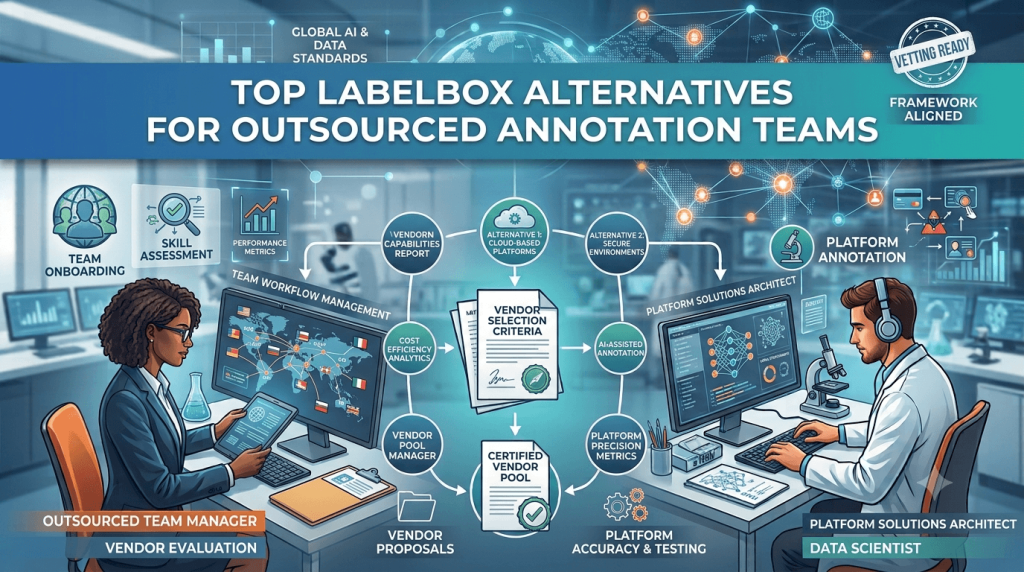
Labelbox is one of the most widely recognised annotation platform brands in the market. Its tooling is capable, its interface is polished, and its model-assisted labeling features are genuinely useful. For teams managing an in-house annotation workforce with engineering resources to configure and maintain the platform, it is a credible choice.
But Labelbox is fundamentally a tooling platform — not a managed annotation service. And that distinction matters enormously when you are working with an outsourced annotation team.
Outsourced annotation teams have a different set of requirements from in-house annotators using a shared platform. They need vendors that can supply and manage the annotation workforce, not just the software. They need quality controls and SLA accountability built into the service, not bolted on after the fact. They need pricing models that reflect annotation output — not per-seat SaaS licenses calibrated for internal teams. And they need operational support for onboarding, calibration, QA, and ongoing project management — not just a feature-rich interface.
This guide evaluates the best Labelbox alternatives for teams that outsource annotation — assessing each option on the criteria that actually matter when your annotators are not your employees: workforce management, quality assurance, pricing structure, domain support, security, and turnaround time. We include both platform alternatives and full-service managed annotation providers, because for outsourced annotation, a managed service is often more appropriate than a platform at all.
| Who This Guide Is For ML engineers, AI product managers, and data leads who currently use or are evaluating Labelbox but need a solution better suited to outsourced annotation workflows — where managing the annotation workforce is not something you want to do yourself. |
1. Why Labelbox Falls Short for Outsourced Annotation Teams
To be clear: Labelbox is a solid platform for certain use cases. This section is not a criticism of Labelbox’s tooling quality — it is an honest assessment of the structural reasons why it is a poor fit for outsourced annotation team models.
1.1 Labelbox Is a Platform, Not a Service
Labelbox provides the software environment for annotation — the interface, the workflow configuration, the quality review tools, and the analytics dashboard. It does not supply annotators, manage annotation quality end-to-end, guarantee turnaround times, or take accountability for annotation output quality. When you outsource annotation, you are trying to offload those responsibilities — not take them on in a new software environment.
Teams using Labelbox with an outsourced workforce typically end up managing the annotator relationship, the quality process, the onboarding and calibration, and the project timeline themselves — using Labelbox as a tool. That is an in-house workload in a different uniform.
1.2 Pricing Is Calibrated for In-House Teams
Labelbox’s pricing model is seat-based and platform-focused — it charges for the number of users accessing the platform, not for the volume of annotation produced. For in-house teams with a stable headcount, this is predictable. For outsourced annotation teams where annotator count fluctuates by project, you pay for capacity you may not use and face cost unpredictability when projects scale.
Full-service managed annotation vendors price per annotated item or per project — aligning their cost directly with annotation output. For outsourced models, this is almost always a better commercial structure.
1.3 Quality Accountability Sits With You
When annotation quality falls below your requirements in Labelbox, the resolution is your problem — you need to re-brief your outsourced annotators, investigate the cause, and implement fixes in your workflow configuration. A managed annotation service takes ownership of quality outcomes: they guarantee accuracy levels, fix below-threshold batches at no charge, and provide QA reporting as part of the service. That is the accountability model outsourced annotation actually requires.
1.4 Workforce Management Overhead Is Hidden
Sourcing, onboarding, training, calibrating, and managing an outsourced annotation team is significant operational work — work that disappears entirely when you use a full-service managed annotation vendor. Teams that use Labelbox with an outsourced workforce often discover this overhead only after they are carrying it. Annotator attrition, calibration drift, coverage gaps when annotators are unavailable — these are workforce management problems, not software problems.
G2’s annotation software category reviews — available at g2.com/categories/data-labeling — provide peer-reviewed user feedback on Labelbox and competing platforms, including specific reviews from teams managing outsourced annotation workflows.
2. The Right Question: Platform or Managed Service?
Before evaluating specific alternatives, clarify which category of solution your team actually needs. The answer shapes everything else.
| ✓ You Need a Platform Alternative | You Need a Managed Service | |
| Workforce | You have your own outsourced annotators and just need better tooling than Labelbox | You want the vendor to supply, manage, and quality-control the annotators |
| Quality | You will run QA yourself; you need better tooling for it | You want guaranteed accuracy levels with the vendor accountable for outcomes |
| Pricing | Seat-based or usage-based platform license is acceptable | Per-item or per-project pricing aligned to annotation output |
| Oversight | You want to own the annotation workflow configuration and management | You want to hand off annotation operations and receive finished, quality-reviewed data |
| Best Fit | Platform alternatives: Label Studio, CVAT, Prodigy, Scale Nucleus | Managed service alternatives: Synnth.ai, Scale AI, Appen, Toloka |
| Our Recommendation For the majority of teams that outsource annotation, a full-service managed annotation vendor is a better fit than any platform alternative to Labelbox — including free open-source tools. The platform saves on licensing cost but recreates the operational burden you were trying to outsource. Evaluate managed services first; evaluate platform alternatives only if you have a specific reason to retain workflow ownership. |
3. Evaluation Criteria for Labelbox Alternatives (Outsourced Team Focus)
The following criteria are weighted specifically for teams using outsourced annotation — they differ from the criteria you would use to evaluate a platform for an in-house team.
| Criterion | Priority | What to Assess |
| Workforce supply & management | Critical | Does the vendor provide and manage annotators, or only the tooling? |
| Quality accountability | Critical | Guaranteed accuracy levels; who is accountable for QA failures? |
| Pricing model | High | Per-item or per-project vs. seat-based; alignment to annotation output |
| Turnaround time SLAs | High | Binding delivery commitments, not estimates |
| Domain expertise | High | Specialist annotators for your task type and domain |
| Onboarding & calibration | High | Who handles annotator training on your task — you or the vendor? |
| Security & data privacy | High | SOC 2 Type II, data residency, access controls |
| Scalability | Medium | Ability to ramp annotator capacity up/down with project needs |
| Tooling & interface | Medium | Annotation interface quality; multi-modal support; integrations |
| Reporting & transparency | Medium | Per-batch QA reports, IAA metrics, annotator-level analytics |
4. Labelbox Alternatives: Full-Service Managed Annotation Providers
These alternatives replace both the Labelbox platform and the workforce management burden — giving you annotated data as the output, not a tooling environment to configure.
1. Synnth.ai — Best Overall for Outsourced AI Annotation Teams
| Synnth.ai Purpose-built managed annotation service for AI product teams |
| Type: Full-service managed annotation (workforce + tooling + QA) |
| Best For: LLM fine-tuning, NLP, computer vision, audio, multimodal, domain-specific annotation |
| Pricing: Per-item and per-project; pilot engagements available; volume discounts |
| Workforce Model: Managed expert annotator network; domain matching; in-house QA team |
| Key Differentiator: End-to-end accountability — Synnth.ai owns quality outcomes, not just tooling |
| Security: SOC 2 Type II aligned; GDPR/DPDP/CCPA compliant; data residency options |
| SLA Model: Binding turnaround commitments; per-batch QA reporting; penalty provisions |
Synnth.ai is designed specifically for the use case that Labelbox is not: teams that want to outsource annotation entirely and receive finished, quality-reviewed, training-ready data — without managing annotation software, annotator workforces, QA processes, or project timelines themselves.
Where Labelbox requires you to configure the workflow, train your annotators, run QA, and manage delivery, Synnth.ai takes ownership of all of it. You define your annotation task, quality requirements, and timeline. Synnth.ai handles everything from annotator selection and onboarding through to final delivery with per-batch quality reports.
- For LLM and NLP teams: Instruction-response pair creation, RLHF preference ranking, NER, intent classification, sentiment annotation, and document processing — with annotators matched to your domain and task complexity.
- For computer vision teams: Image classification, bounding box, semantic segmentation, keypoint annotation, and 3D point cloud labeling with AI-assisted pre-labeling to accelerate throughput.
- For audio and multimodal teams: Speech transcription, speaker diarization, paralinguistic annotation, and multi-layer multimodal labeling in a single coordinated workflow.
- Continuous production pipelines: For teams with deployed models, Synnth.ai supports ongoing annotation of production data — sampling, filtering, pre-annotating, reviewing, and delivering labeled batches on a defined cadence.
| ✓ Strengths for Outsourced Teams | ⚠ Limitations for Outsourced Teams |
| • Full-service: workforce, tooling, QA, delivery all managed • Per-item pricing aligned to annotation output • Binding SLAs with penalty provisions • Domain-expert annotator matching • Real-time IAA and quality dashboards • No platform configuration or maintenance overhead | • Less direct tooling control for teams wanting to own the annotation UI • Not a self-serve platform — requires engagement with Synnth.ai team • Platform customization limited compared to open-source tools |
2. Scale AI — Best for High-Volume Enterprise Outsourced Annotation
| Scale AI Enterprise AI data platform with managed annotation services |
| Type: Platform + managed workforce (Tasker network and enterprise managed service) |
| Best For: High-volume annotation; LLM training data at scale; RLHF; enterprise ML teams |
| Pricing: Enterprise contract; minimum engagement thresholds; custom pricing |
| Workforce Model: Scale’s proprietary Tasker network + enterprise dedicated teams |
| Key Differentiator: Highest throughput capacity; mature RLHF data infrastructure; strong LLM track record |
| Security: SOC 2 Type II, ISO 27001, FedRAMP (government) |
| SLA Model: Enterprise SLA with dedicated account management |
Scale AI is the dominant player in high-volume, enterprise-grade annotation. For teams that need to annotate hundreds of millions of data points, Scale has the infrastructure, workforce capacity, and engineering depth to deliver. Its Nucleus platform adds dataset management and model evaluation on top of annotation — useful for teams that want annotation and evaluation in one environment.
Scale’s managed workforce model (via the Tasker network and dedicated enterprise teams) means it functions as a managed service for most enterprise clients, not just a tooling platform. For outsourced annotation, this makes it a stronger fit than Labelbox’s platform-only model.
The primary limitation for smaller teams and startups is commercial: Scale’s pricing and minimum engagement requirements are calibrated for large enterprises. If your annotation budget is under $50,000 per project, Scale’s commercial model may not be well-matched to your scale.
Scale AI’s platform and managed services are documented at scale.com [https://scale.com] — request Scale’s managed annotation service tier documentation specifically, separate from their platform licensing.
| ✓ Strengths for Outsourced Teams | ⚠ Limitations for Outsourced Teams |
| • Highest throughput capacity in the market • Mature RLHF and LLM data infrastructure • SOC 2 Type II and ISO 27001 certified • Strong LLM and foundation model client track record • Nucleus platform for dataset management + annotation in one | • Minimum engagement thresholds exclude smaller teams • Enterprise pricing not well-matched to startup/mid-market budgets • Less domain-specialist depth for niche verticals • Account management quality varies by contract tier |
3. Appen — Best for Multilingual and Global-Scale Outsourced Annotation
| AppenGlobal AI training data collection and annotation platform |
| Type: Managed service + crowd platform (hybrid) |
| Best For: Multilingual NLP; global-scale data collection + annotation; diverse demographic coverage |
| Pricing: Project-based and managed service; flexible for mid-to-large projects |
| Workforce Model: 1M+ global contractor network; managed service tier for enterprise |
| Key Differentiator: Unmatched multilingual and geographic annotator diversity; both data collection and annotation |
| Security: ISO 27001, SOC 2 Type II, GDPR compliant |
| SLA Model: Managed service SLAs for enterprise tier; project-based delivery for standard tier |
Appen’s primary differentiator for outsourced annotation teams is global scale and multilingual depth. With over one million contractors across 170+ countries, Appen can supply annotators for virtually any language, dialect, or demographic requirement — a capability that no other vendor in this guide matches.
For AI product teams building multilingual models, global voice assistants, or products targeting diverse demographic populations, Appen’s annotator diversity is not just a feature — it is a strategic asset. You can source native speakers of Swahili, Tagalog, and Bengali alongside English in a single project, with consistent quality standards across all cohorts.
Appen’s managed service tier handles workforce management, QA, and delivery end-to-end — making it a genuine managed alternative to Labelbox for teams that need outsourced annotation with global reach. Their project management layer is strong, though the crowd-sourced model can introduce consistency variability on complex, domain-specific tasks unless you specifically request their enterprise managed tier.
Appen’s annotation services and multilingual capabilities are detailed at appen.com [https://appen.com] — specifically request their enterprise managed service documentation for outsourced annotation engagements.
| ✓ Strengths for Outsourced Teams | ⚠ Limitations for Outsourced Teams |
| • Unmatched multilingual annotator coverage (170+ countries) • Both data collection and annotation in one vendor • SOC 2 Type II and ISO 27001 certified • Strong enterprise project management layer • Flexible for mid-to-large scale projects | • Crowd model introduces consistency risk on complex tasks • Enterprise managed tier required for domain-specialist quality • Less specialised for LLM fine-tuning and RLHF workflows • Platform interface less modern than Labelbox or Scale Nucleus |
4. Toloka AI — Best for Cost-Efficient High-Volume Outsourced Annotation
| Toloka AI Crowdsourcing and AI-assisted annotation platform with managed services |
| Type: Crowd platform + AI-assisted tooling + managed service option |
| Best For: High-volume, cost-sensitive annotation; computer vision; NLP classification at scale |
| Pricing: Per-task pricing (crowd); managed service pricing for enterprise; competitive rates at volume |
| Workforce Model: Global crowd (5M+ workers) + dedicated managed teams on request |
| Key Differentiator: Cost efficiency at scale; strong AI-assisted pre-labeling; built-in quality aggregation |
| Security: ISO 27001, GDPR compliant; SOC 2 in progress (verify current status) |
| SLA Model: Managed service SLAs for enterprise engagements |
Toloka AI (formerly Yandex Toloka) has one of the largest crowdsourcing pools globally — over five million workers — and has invested heavily in AI-assisted annotation tooling that reduces human annotation effort through automated pre-labeling and quality aggregation. For high-volume, cost-sensitive annotation tasks — image classification, basic NLP categorization, data collection at scale — Toloka’s per-task pricing model is among the most competitive in the market.
For outsourced annotation teams, Toloka’s managed service tier handles workforce management, quality control, and delivery end-to-end. Their built-in quality aggregation algorithms (majority voting, Dawid-Skene, GLAD) automatically resolve disagreements between crowd workers without requiring manual adjudication on every disputed item — a genuine efficiency advantage for high-volume tasks.
Domain-specialist tasks — medical annotation, legal NLP, complex financial labeling — are less well-suited to Toloka’s general crowd model. For these, their managed service tier with specifically recruited expert workers is a better option, though this is more expensive and reduces the per-task cost advantage.
Toloka AI’s platform documentation and managed service options are available at toloka.ai [https://toloka.ai] — evaluate their quality aggregation methodology documentation specifically when assessing fitness for complex annotation tasks.
| ✓ Strengths for Outsourced Teams | ⚠ Limitations for Outsourced Teams |
| • Highly competitive per-task pricing at volume • 5M+ worker pool for high-volume throughput • Strong AI-assisted pre-labeling capability • Built-in quality aggregation reduces manual adjudication overhead • Managed service tier available for outsourced full-service needs | • Crowd model less reliable for complex or domain-specific tasks • ISO 27001 only — verify SOC 2 status for security-sensitive projects • Less mature LLM and RLHF data collection tooling • Platform UI less intuitive than Labelbox or Scale Nucleus for non-technical users |
5. Surge AI — Best for High-Quality NLP and LLM Annotation
| Surge AI High-quality NLP data labeling with a vetted, US-based annotator workforce |
| Type: Managed annotation service focused on NLP and LLM data quality |
| Best For: LLM fine-tuning data; RLHF; instruction-response pairs; sensitive NLP tasks requiring English fluency |
| Pricing: Per-task and project-based; premium relative to crowd platforms |
| Workforce Model: Vetted US-based annotator pool; quality-first hiring; managed QA |
| Key Differentiator: US-based, highly educated annotator workforce producing consistently higher NLP quality |
| Security: SOC 2 Type II; GDPR compliant |
| SLA Model: Project-based delivery commitments; quality guarantees |
Surge AI was purpose-built to address the quality limitations of general-purpose crowdsourcing for NLP tasks. Its annotator workforce is vetted, US-based, and selected for language proficiency and reasoning ability — making it particularly well-suited to tasks where annotator judgment quality directly affects model output: RLHF preference ranking, instruction-response pair creation, complex NLP classification, and sensitive content evaluation.
For teams fine-tuning LLMs where annotation quality is the primary variable distinguishing a useful model from a frustrating one, Surge AI’s workforce quality advantage is real and measurable. The premium pricing relative to crowd platforms reflects genuine quality investment — vetted annotators with higher task accuracy and lower variance than open crowd models.
The primary limitation is scope: Surge AI is strongest on English-language NLP tasks. Computer vision, audio annotation, multilingual requirements, and high-volume structured data labeling are less well-served by their platform and workforce model.
Surge AI’s annotation platform and NLP data capabilities are documented at surgehq.ai [https://www.surgehq.ai] — particularly relevant for teams evaluating Labelbox alternatives for RLHF and LLM fine-tuning data collection.
| ✓ Strengths for Outsourced Teams | ⚠ Limitations for Outsourced Teams |
| • Highest English-language NLP annotation quality in its tier • US-based, vetted workforce reduces quality variance • Purpose-built for LLM fine-tuning and RLHF data • SOC 2 Type II certified • Full managed service model — no workforce management overhead | • Premium pricing vs. crowd alternatives • Limited multilingual capability • Less suited to computer vision, audio, or structured data tasks • Smaller workforce pool limits throughput at very high volumes |
6. Datasaur — Best Platform Alternative with Strong Outsourced Workflow Support
| Datasaur NLP annotation platform with built-in outsourced team management features |
| Type: Platform (tooling) with outsourced team management features |
| Best For: Teams that want a platform alternative to Labelbox with better support for external annotator management |
| Pricing: SaaS platform license; per-seat pricing; startup-friendly tiers |
| Workforce Model: Platform only — you supply the annotators; better tooling for managing external teams than Labelbox |
| Key Differentiator: Designed with external annotator management in mind; role-based access; project manager workflows |
| Security: SOC 2 Type II; GDPR compliant |
| SLA Model: Platform SLA (uptime/availability); no annotation output guarantees |
Datasaur occupies an interesting position in this comparison: it is a platform alternative to Labelbox — not a managed service — but it is explicitly designed with outsourced annotator management in mind. Where Labelbox’s workforce management features are designed primarily for in-house teams, Datasaur’s role-based access controls, project manager workflow layer, and annotator performance tracking are built for the scenario where your annotators are external contractors rather than employees.
For teams that want to retain control of their annotation workflow and workforce — managing external annotators through a platform rather than delegating to a managed service — Datasaur is the most purpose-fit platform alternative to Labelbox for outsourced team models.
It is strongest for NLP tasks: text classification, NER, relation extraction, document annotation, and conversational AI data. Computer vision and audio annotation support are present but less developed than dedicated CV platforms. Pricing is more startup-friendly than Labelbox, with lower minimum commitments and a meaningful free tier for small projects.
Datasaur’s annotation platform is documented at datasaur.ai [https://datasaur.ai] — evaluate their team management and external annotator workflow features specifically against your outsourced team management requirements.
| ✓ Strengths for Outsourced Teams | ⚠ Limitations for Outsourced Teams |
| • Designed for external annotator management — better than Labelbox here • Startup-friendly pricing with lower minimum commitment • Strong NLP annotation tooling • SOC 2 Type II certified • Role-based access controls fit for outsourced team workflows | • Platform only — you still manage the annotation workforce • Less developed for computer vision and audio tasks • Smaller ecosystem and integrations than Labelbox • No annotation output quality guarantees — QA is your responsibility |
5. Open-Source Platform Alternatives to Labelbox
If you want to eliminate platform licensing costs entirely while retaining control of your annotation workflow and tooling, open-source annotation platforms are worth evaluating. These are not managed services — they require engineering effort to deploy, configure, and maintain — but they give teams maximum flexibility and no per-seat cost.
5.1 Label Studio
Label Studio is the most popular open-source annotation platform, supporting text, image, audio, video, and time-series annotation in a single unified interface. It can be self-hosted or used via Label Studio Enterprise (a managed cloud version with added security and team management features).
- Strengths: Multi-modal support; active open-source community; extensive integration ecosystem; Label Studio Enterprise adds team management and SSO.
- Limitations for outsourced teams: Requires engineering effort to deploy and maintain; no managed workforce; QA processes must be built custom; no SLA or quality guarantees.
Label Studio is available at labelstud.io [https://labelstud.io] — the open-source repository is maintained by Heartex and has 17,000+ GitHub stars as of 2026.
5.2 CVAT (Computer Vision Annotation Tool)
CVAT — developed by Intel and now maintained as an open-source project — is the leading open-source platform for computer vision annotation. It supports image and video annotation including bounding boxes, polygons, keypoints, segmentation masks, and 3D point clouds.
- Strengths: Best-in-class computer vision annotation tooling; free and open source; strong community; CVAT.ai offers a hosted version.
- Limitations for outsourced teams: CV-focused (limited NLP and audio support); no managed workforce; requires engineering resources to self-host.
CVAT is available at cvat.ai — the open-source project is available on GitHub and CVAT.ai provides a hosted cloud version for teams without self-hosting infrastructure.
5.3 Prodigy (by Explosion AI)
Prodigy is a commercial annotation tool from the creators of spaCy, built specifically for NLP annotation with a focus on active learning and annotation efficiency. It is not open-source but is inexpensive (one-time license fee) and installs locally without per-seat fees.
- Strengths: Exceptional for NLP annotation; active learning reduces annotation volume needed; seamless spaCy integration; one-time license, no ongoing SaaS fees.
- Limitations for outsourced teams: Designed for individual or small team use — less suited to managing large external annotator pools; no managed workforce; limited multi-modal support.
Prodigy is documented at prodi.gy — particularly well-suited to teams building custom NLP models with spaCy or training small, high-quality NLP datasets.
6. Feature Comparison: Labelbox vs. Top Alternatives
This table compares Labelbox against the primary alternatives profiled in this guide across the criteria most relevant for outsourced annotation teams:
| Feature | Labelbox | Synnth.ai | Scale AI | Appen | Toloka AI | Datasaur |
| Managed workforce | ✕ | ✓ | ✓ | ✓ | ✓ | ✕ |
| Quality SLA / guarantee | ✕ | ✓ | ✓ | Partial | Partial | ✕ |
| Per-item pricing | ✕ | ✓ | ✓ | ✓ | ✓ | ✕ |
| Domain expert annotators | ✕ | ✓ | Partial | Partial | Partial | ✕ |
| IAA / QA reporting | Tooling only | ✓ Managed | ✓ Managed | ✓ Managed | Partial | Tooling only |
| Multilingual support | Platform | ✓ 40+ langs | ✓ | ✓✓ 170+ | ✓ | Platform |
| LLM / RLHF support | Partial | ✓ | ✓✓ | Partial | Partial | Partial |
| SOC 2 Type II | ✓ | ✓ Aligned | ✓ | ✓ | Verify | ✓ |
| Startup-friendly pricing | Moderate | ✓ | ✕ | Moderate | ✓ | ✓ |
| Outsourced team fit | Low | Very High | High | High | Medium | Medium |
7. How to Choose the Right Labelbox Alternative for Your Team
Use this decision framework to match your specific situation to the right alternative:
Choose Synnth.ai if:
- You want to fully outsource annotation operations — workforce, QA, delivery — and receive finished, training-ready data.
- Your annotation tasks include NLP, LLM fine-tuning, RLHF, audio, or multimodal data with domain-specific requirements.
- You need binding SLAs with penalty provisions and per-batch quality reporting.
- You are a startup, scale-up, or mid-market AI team that needs production-grade annotation without enterprise minimum spend thresholds.
Choose Scale AI if:
- You are an enterprise team with large annotation budgets (typically $50,000+ per project).
- You need the highest throughput capacity for very high-volume annotation.
- LLM training data and RLHF at scale are your primary use case.
- FedRAMP compliance is a requirement (government and defense adjacent teams).
Choose Appen if:
- Multilingual annotation across many languages is a core requirement.
- You need both data collection and annotation from a single vendor.
- Your project requires demographic diversity in your annotator pool.
- You are building global products that need culturally diverse training data.
Choose Toloka AI if:
- You need very high volume annotation at competitive per-task pricing.
- Your task types are well-suited to crowd annotation (image classification, basic NLP, data collection).
- Built-in quality aggregation for crowd disagreements is valuable to your workflow.
Choose Surge AI if:
- Your primary need is high-quality English-language NLP or LLM data.
- Annotator judgment quality is the primary variable in your model’s performance.
- RLHF preference ranking and instruction pair quality matter more than cost.
Choose Datasaur if:
- You want a platform alternative to Labelbox with better external annotator management features.
- You want to retain control of your annotation workflow but need better tooling for managing outsourced teams.
- Your tasks are primarily NLP-focused.
- Your annotation budget does not accommodate managed service pricing.
Choose Label Studio / CVAT if:
- Eliminating platform licensing costs is a priority and you have engineering resources to self-host.
- You want maximum flexibility and open-source community support.
- Your team can handle deployment, maintenance, and workflow configuration in-house.
Frequently Asked Questions (FAQs)
The primary reason is accountability. Labelbox gives you tooling — the responsibility for annotation quality, workforce management, and delivery timelines remains with you. A managed annotation service like Synnth.ai takes ownership of those outcomes: they guarantee accuracy levels, fix quality failures at their cost, and commit to delivery schedules with contractual consequences if they miss. For teams that outsource annotation precisely to reduce operational burden, a platform that requires you to manage the workforce is not actually solving the outsourcing problem.
Yes, with the right setup — but it requires more overhead than most teams expect. To use Labelbox effectively with an outsourced annotation team, you need to manage annotator access and permissions, train annotators on your task using Labelbox’s interface, configure QA workflows yourself, monitor quality metrics and act on them, and manage delivery timelines directly with your outsourced workforce. For teams that want to own those processes and have engineering resources to support them, Labelbox is workable. For teams that want to hand off those processes, it is not the right choice.
Labelbox pricing is seat-based and platform-focused — you pay for access to the tool regardless of annotation volume. Synnth.ai prices per annotated item or per project — cost scales directly with annotation output. For most projects, Synnth.ai’s total cost (annotation labor + QA + delivery, all included) is comparable to or lower than Labelbox’s platform license plus the separate cost of managing an outsourced annotation workforce. The more significant saving is operational: the internal team time spent managing annotation operations through Labelbox represents a real cost that managed service pricing eliminates.
Yes, and it is typically straightforward. Most managed annotation services including Synnth.ai can accept annotation tasks defined in common formats (JSON, CSV, existing Labelbox exports) and map them to their own workflow without requiring you to redefine the task from scratch. The key transition consideration is annotator re-calibration: if you have an established annotation standard and guidelines, share them with your new vendor’s onboarding team so their annotators are calibrated to your quality expectations from the first batch.
An annotation platform provides software tooling for annotation — the interface, workflow configuration, quality review tools, and analytics. You bring the annotators, manage the workforce, run QA, and own delivery. A managed annotation service provides all of that plus the annotator workforce, quality management, and delivery accountability. For outsourced annotation, the critical difference is: with a platform, you are still managing annotation operations. With a managed service, you are not.
For LLM fine-tuning and RLHF data specifically, Synnth.ai and Scale AI are the strongest full-service alternatives, and Surge AI is the strongest option if you specifically need US-based, highly educated English-language annotators for preference ranking and instruction pair quality. Scale AI has the most mature RLHF infrastructure for very large scale. Synnth.ai offers the best combination of domain-expert annotator matching, LLM fine-tuning task support, and commercial flexibility for teams that are not enterprise-sized.
Most managed annotation services offer paid pilot projects — small-scale engagements (typically 500–2,000 items) that let you evaluate annotation quality on your actual data before committing to a full project. This is strongly recommended for any new vendor relationship. Synnth.ai offers pilot engagements for new clients. Open-source platforms (Label Studio, CVAT) are free to use without any pilot commitment. Datasaur offers a free tier for small projects. Scale AI and Appen typically require enterprise conversations before a pilot is structured.
Conclusion
Labelbox is a capable annotation platform — but platform is the operative word. For teams that outsource annotation to reduce operational burden, a platform that requires you to supply and manage the workforce, run QA processes, and own delivery accountability is not solving the right problem. It is giving you a better environment to manage a problem you were trying to hand off.
The right Labelbox alternative for outsourced annotation teams is almost always a managed annotation service: a vendor that takes full ownership of annotation operations and delivers finished, quality-reviewed, training-ready data. That is what Synnth.ai, Scale AI, Appen, Toloka AI, and Surge AI each offer — in different configurations suited to different team sizes, task types, and budget structures.
If you specifically want to retain tooling control while improving your management of outsourced annotators, Datasaur offers the best platform-level alternative. If you want to eliminate licensing costs entirely, Label Studio and CVAT are mature open-source options — with the engineering overhead that entails.
The right choice depends on your task type, volume, quality requirements, domain, and how much annotation operational overhead you actually want to carry. This guide gives you the framework to make that decision with clarity.
Ready to see how Synnth.ai compares for your specific annotation needs? Visit synnth.ai to request a pilot project proposal.
Related Articles from Synnth.ai
Continue building your annotation strategy with these related guides from the Synnth.ai blog:
→ Data Annotation SLAs Explained: Turnaround Times, QA Guarantees & Penalties
https://synnth.ai/blog/data-annotation-sla-turnaround-qa-guarantees-penalties
Everything you need to negotiate a binding annotation vendor SLA — turnaround benchmarks, QA standards, penalty structures, escalation clauses, and a 24-item checklist.
→ Data Labeling Cost Calculator: Budgeting for Your Next ML Project
https://synnth.ai/blog/data-labeling-cost-calculator-ml-project-budgeting
Benchmark annotation pricing by task type, a step-by-step budget calculator, hidden cost breakdowns, and three real-world project budget scenarios.
→ Best Data Annotation Vendors for Financial Services & Fraud Detection AI
https://synnth.ai/blog/best-data-annotation-vendors-financial-services-fraud-detection-ai
A vendor evaluation guide specifically for financial services AI teams — covering security requirements, fraud-specific annotation challenges, and detailed vendor profiles.
→ What Is Data Annotation? The Complete Guide for AI Product Teams in 2026
https://synnth.ai/blog/what-is-data-annotation-guide-ai-product-teams
A comprehensive introduction to data annotation — types, methodologies, workflows, and quality metrics — for AI product teams building and shipping ML systems.
Sources & Further Reading
The following authoritative sources were referenced or linked in this article:
G2: Data Labeling Software Reviews and Comparisons — https://www.g2.com/categories/data-labeling
Peer-reviewed user feedback on Labelbox and competing annotation platforms — includes reviews from teams managing outsourced annotation workflows.
Label Studio — Open Source Data Labeling Platform — https://labelstud.io
The leading open-source annotation platform supporting text, image, audio, video, and time-series data — maintained by Heartex with an active open-source community.
CVAT — Computer Vision Annotation Tool — https://cvat.ai
Intel’s open-source computer vision annotation platform — the leading free tool for image and video annotation including bounding boxes, segmentation, keypoints, and 3D point clouds.
Prodigy — Annotation Tool by Explosion AI — https://prodi.gy
Commercial NLP annotation tool from the creators of spaCy — active learning approach reduces annotation volume required; one-time license model.
Scale AI — Enterprise AI Data Platform — https://scale.com
Scale AI’s enterprise annotation platform and managed workforce documentation — relevant for teams evaluating high-volume outsourced annotation at enterprise scale.
Appen — AI Training Data and Annotation Services — https://appen.com
Appen’s multilingual annotation services documentation — relevant for teams with global-scale or multilingual annotation requirements.
Toloka AI — Crowdsourcing and Annotation Platform — https://toloka.ai
Toloka AI’s platform documentation covering crowd annotation, AI-assisted labeling, and quality aggregation methodology.
Surge AI — High-Quality NLP Data Labeling — https://www.surgehq.ai
Surge AI’s managed annotation service for NLP and LLM data — relevant for teams prioritizing annotation quality over cost for English-language tasks.
Datasaur — NLP Annotation Platform — https://datasaur.ai
Datasaur’s annotation platform documentation — specifically relevant for teams seeking a platform alternative to Labelbox with better outsourced team management features.