
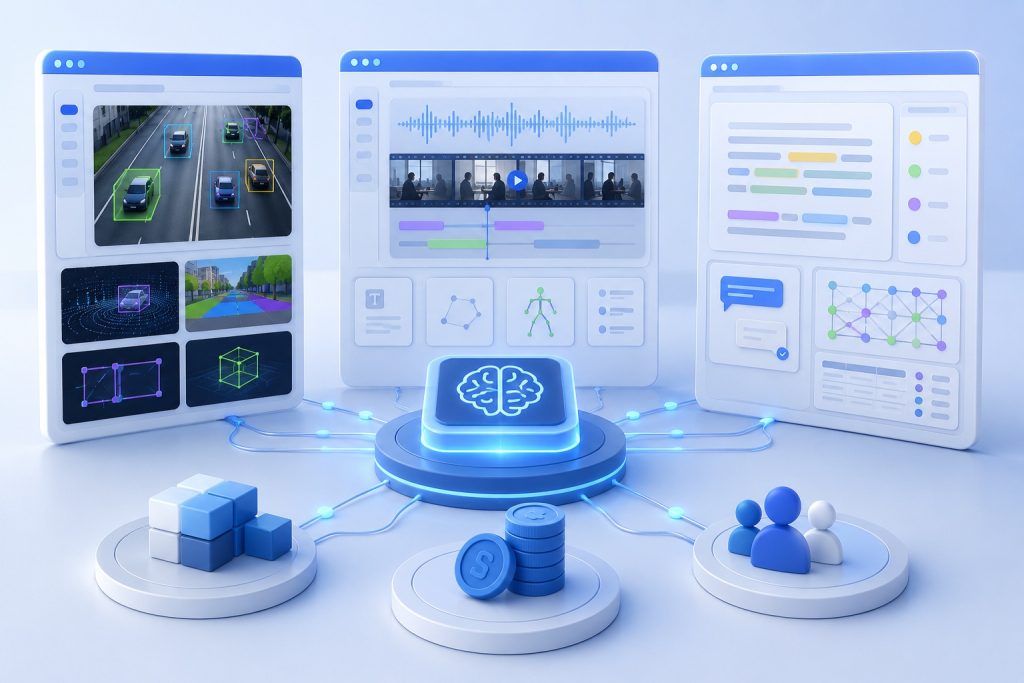
Search for “data annotation tools” and you’ll be met with a crowded, fast-moving landscape: open-source labeling frameworks, enterprise annotation platforms, model-assisted labeling suites, and fully managed data services that bundle tooling with a trained annotation workforce. For AI teams trying to choose the right approach, the sheer number of options can make the decision feel harder than it needs to be — especially since the “best” tool genuinely depends on the task, the data modality, the team’s scale, and how much of the annotation workforce itself needs to be managed alongside the software.
This isn’t a ranked list of specific vendors, since the landscape shifts too quickly for that to stay useful for long. Instead, this is a framework for understanding the real categories of annotation tools available, what each is actually built for, where the costs show up, and how to match a tool category — or a fully managed partner like Synnth AI — to the specific annotation challenge a team is facing.
The Core Categories of Data Annotation Tools
Before comparing specific features, it helps to understand the broad categories most annotation tools fall into, since teams often compare tools across categories that were never designed to solve the same problem.
Open-Source Labeling Frameworks
Open-source tools provide flexible, self-hosted labeling interfaces that teams can customize and integrate into their own infrastructure without licensing fees. They’re a strong fit for teams with in-house engineering capacity to configure, host, and maintain the tooling themselves, and for projects where full control over data handling and infrastructure is a priority.
The trade-off is that open-source tools typically come without a built-in annotation workforce, project management support, or dedicated quality assurance infrastructure — teams get the software, but still need to solve annotator sourcing, training, and QA on their own, which is a substantial undertaking, as covered in Synnth AI’s comparison of data annotation outsourcing versus in-house approaches.
Enterprise Annotation Platforms
Enterprise platforms offer more polished, feature-rich labeling interfaces with built-in project management, workflow automation, and often some layer of quality assurance tooling, typically available through a software licensing or seat-based subscription model. These platforms usually support multiple data modalities — image, text, video, audio — within a single interface, which appeals to teams working across several annotation types at once.
The cost structure here typically scales with seats, data volume, or both, and while the software itself is often robust, teams still need to recruit, train, and manage their own annotator workforce to actually use the platform at scale, unless they pair it with a managed annotation service.
Model-Assisted and Auto-Labeling Tools
A growing category of annotation tools incorporates AI-assisted pre-labeling directly into the workflow — using an existing model to generate draft labels that human annotators then review and correct rather than creating from scratch. This can meaningfully speed up annotation for tasks like object detection, segmentation, and text classification, particularly as covered in Synnth AI’s breakdown of avoiding the frame-labeling bottleneck in video annotation at scale, where model-assisted pre-labeling is one of the most effective techniques for managing video’s especially high annotation volume.
The trade-off with these tools is that pre-labeling quality is only as good as the underlying model, and teams need annotator training and QA processes specifically designed to catch cases where annotators over-trust an incorrect pre-label rather than catching it — a risk worth building into any workflow using this category of tool.
Fully Managed Data Annotation Services
Rather than software alone, fully managed services like Synnth AI combine annotation tooling with a trained, managed annotator workforce, project management, and built-in quality assurance — effectively outsourcing not just the software but the entire annotation operation. This category is generally the best fit for teams that need annotation at meaningful scale but don’t want to build and manage recruiting, training, and QA infrastructure internally, a trade-off explored in depth in Synnth AI’s guidance on how to choose an AI data annotation partner.
Cost here is typically structured per-label, per-hour, or per-project rather than as a software license, and while the per-unit cost can look higher in isolation compared to a pure software tool, it often bundles in costs — recruiting, training, QA infrastructure — that a software-only approach leaves for the team to handle separately.
Comparing Tools Across Key Dimensions
Feature Depth by Data Modality
Not all annotation tools handle every data type equally well. Tools built primarily for image annotation often have limited or bolted-on support for video’s temporal dimension — tracking, interpolation, and frame-level consistency — which matters significantly given how different video annotation requirements are from static image annotation. Similarly, tools strong in bounding box and polygon annotation for computer vision don’t necessarily translate well to the entity, intent, and sentiment labeling needs of text annotation for NLP, or the transcription and phonetic labeling needs of audio annotation. Evaluating a tool’s actual depth in the specific modality a project needs — rather than a generic multi-modal feature checklist — is one of the most important and most commonly skipped evaluation steps.
Quality Assurance Infrastructure
Some tools offer built-in inter-annotator agreement tracking, consensus workflows, and review tiers; others provide only the labeling interface itself and leave QA process design entirely to the team. Synnth AI’s detailed framework for evaluating data annotation quality through metrics, QA processes, and red flags is a useful reference point for what a genuinely rigorous QA layer should include, regardless of which specific tool or provider a team ultimately chooses.
Integration With Existing ML Pipelines
Tools vary considerably in how easily they integrate into an existing ML workflow — some offer robust APIs and pipeline integrations, while others function more as standalone labeling interfaces requiring manual data import and export. For teams aiming to treat annotation as a continuous, integrated part of model development rather than a one-off phase, Synnth AI’s perspective on integrating data annotation into ML pipelines and CI/CD workflows is a helpful lens for evaluating how well a given tool actually fits into a modern, iterative development cycle.
Workforce Availability and Domain Expertise
Software alone doesn’t label data — people do, whether that’s an internal team or an external workforce. Tools that don’t come bundled with a workforce require teams to solve recruiting and training themselves, which is a significant undertaking for specialized domains. This is where fully managed services differentiate themselves most clearly, since providers like Synnth AI bring pre-vetted, trained annotators with relevant domain expertise across specialized areas without requiring the client team to build that expertise from scratch.
Total Cost of Ownership, Not Just License Price
A tool’s sticker price rarely reflects its total cost. Open-source tools carry hosting, maintenance, and engineering overhead; enterprise platforms carry license and seat costs plus workforce management overhead; fully managed services bundle more into a per-unit price but reduce the hidden operational burden considerably. Evaluating total cost of ownership, rather than just comparing headline pricing, is essential to making an honest comparison across categories.
Matching Tool Category to Project Needs
Early-Stage Prototyping and Small Datasets
For early-stage projects validating a model concept with a small dataset, open-source or lightweight tools are often sufficient, since the overhead of a fully managed service may not be justified until the project scales. This is a reasonable place to start cheaply and iterate quickly.
Ongoing, High-Volume Annotation Needs
For teams with steady, large-scale annotation demand, either a mature in-house team using an enterprise platform or a fully managed partner becomes the more practical choice, since the operational overhead of coordinating a large annotation workforce on top of a bare-bones tool becomes substantial at scale. Synnth AI’s guidance on structuring annotation projects for efficiency is a useful resource for teams weighing exactly this transition point.
Highly Specialized or Regulated Domains
For domains requiring deep subject-matter expertise — medical imaging, legal document review, multilingual speech data — a fully managed service with access to relevant domain-expert annotators is generally the more reliable path than attempting to source and train that expertise internally from scratch, particularly for teams whose core competency lies elsewhere.
Complex, Multi-Modal Video and Sensor Data
For particularly demanding annotation tasks like autonomous vehicle sensor data or dense video object tracking, purpose-built tooling with strong interpolation, tracking, and multi-sensor fusion support matters far more than general-purpose feature breadth. Synnth AI’s guidance on data labeling best practices for complex image and video use cases offers a useful checklist for what this kind of tooling actually needs to support well.
Common Mistakes When Comparing Annotation Tools
Evaluating tools purely on feature checklists rather than actual task fit. A tool that claims support for ten data modalities may only handle two of them well. Depth in the modality that actually matters for a given project is far more important than breadth across modalities that don’t.
Underestimating the workforce and QA burden that comes with software-only tools. Teams sometimes select a well-reviewed software platform without accounting for the very real cost and complexity of recruiting, training, and managing the human annotators who will actually use it.
Comparing per-unit pricing across categories without adjusting for what’s bundled. A managed service’s per-label price and a software platform’s seat license aren’t directly comparable numbers unless the full scope of what each includes is accounted for honestly.
Not revisiting tool choice as project scale and complexity change. A tool that worked well for an early prototype may not be the right fit once a project scales to production volume or expands into more specialized domains — this is worth reassessing deliberately rather than sticking with the original choice by default. Synnth AI’s complete beginner’s guide to data annotation in AI and its companion piece on what data annotation actually is for AI product teams are both useful starting points for teams reassessing their approach as needs evolve.
Making the Right Choice for Your Team
There’s no single best annotation tool — only the right category of tool for a specific task, data modality, scale, and level of domain specialization. Teams evaluating their options should start by being honest about which parts of the annotation problem they actually want to own — the software, the workforce, the quality assurance — and which parts would be better handled by a partner with existing infrastructure already built for the purpose.
For teams that decide a fully managed approach makes the most sense, Synnth AI combines purpose-built annotation tooling across image, text, video, and audio data with a trained, domain-expert annotator workforce and rigorous quality assurance — removing the need to separately solve software selection, workforce recruiting, and QA infrastructure as three distinct problems. Whichever path a team chooses, the goal stays the same: getting from raw data to reliably labeled data as efficiently as possible, without quietly trading away the quality the resulting model will depend on.