
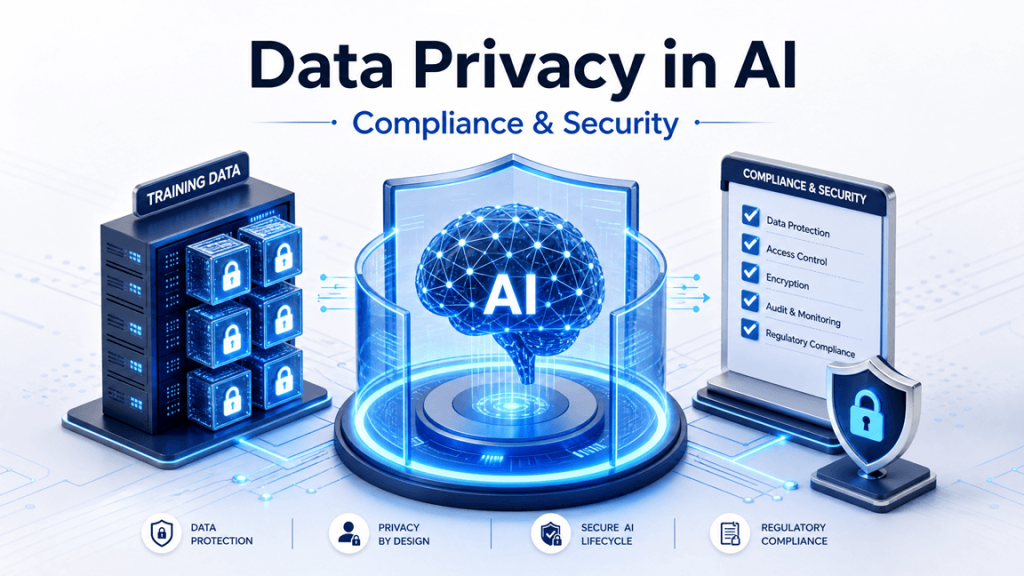
Every AI model is, in some sense, a compressed record of the data it was trained on. That is precisely why training data has become one of the most scrutinised assets in the modern enterprise — and why data privacy can no longer be treated as a downstream legal concern bolted onto an AI project after the fact.
2026 marks a turning point. The EU AI Act’s high-risk provisions become fully enforceable in August, more than twenty US states now have comprehensive privacy laws in effect, and regulators on both sides of the Atlantic are explicitly naming “training data” as a category subject to direct oversight — not just an internal engineering detail.
For teams building or fine-tuning AI models, this changes the calculus. Privacy and security can’t be a checklist applied at the end of a data pipeline. They have to be embedded in how data is sourced, processed, labelled, stored, and retired — from day one.
This post breaks down what data privacy actually means in an AI training context, the regulatory landscape you need to navigate, and the concrete practices that keep your training data compliant and secure.
| Key TakeawayTraining data is no longer a private engineering artifact — it is a regulated asset. Compliance and security need to be built into your data pipeline architecture, not retrofitted once a model is already in production. |
1. Why Training Data Is a Privacy Problem, Not Just a Security Problem
Privacy and security are related but distinct. Security is about protecting data from unauthorised access. Privacy is about whether the data should have been collected, processed, or used in a given way in the first place — regardless of how well it’s protected.
AI training data raises privacy questions that traditional data security practices were never designed to answer:
- Large models can memorise and later reproduce specific examples from their training data — including personal information that was never meant to be retrievable. Memorisation risk:
- Models trained on aggregated data can sometimes be used to infer sensitive attributes about individuals, even when that data was technically anonymised. Inference risk:
- Data collected for one purpose (e.g. customer support) is often repurposed for AI training — a use the original data subject may never have consented to. Consent scope:
- Datasets aggregated from multiple sources, vendors, or web scrapes often carry unclear or undocumented consent and licensing status. Provenance ambiguity:
These risks don’t disappear once a model is deployed. They persist for the lifetime of the model — which is why regulators increasingly treat training data governance as a continuous obligation, not a one-time intake step.
2. The Regulatory Landscape in 2026
The regulatory environment for AI training data has shifted from broad principles to specific, enforceable obligations. Here is a snapshot of the frameworks most likely to affect your training data pipeline right now.
| Regulation | Jurisdiction | Key Training Data Obligation | Key Deadline |
| EU AI Act (Article 10) | EU / EU-facing systems | High-risk AI training data must be relevant, representative, error-checked, and bias-audited with full documentation | Aug 2, 2026 (high-risk systems) |
| EU AI Act (Article 53) | GPAI model providers | Public summary of training data sources required, using EU AI Office template | In effect (Aug 2025) |
| GDPR | EU / EEA | Lawful basis, data minimisation, and purpose limitation apply to personal data used in training | In effect |
| CCPA / CPRA (California) | California, US | Risk assessments required before training automated decision-making tech on personal data | In effect (2026 regs) |
| Colorado SB 26-189 | Colorado, US | Governs automated decision-making in employment, lending, healthcare, and other consequential domains | Jan 1, 2027 |
| CA AB 2013 | California, US | Generative AI developers must publish high-level training data documentation | In effect |
| State Privacy Laws (20+ states) | US (varies) | Consent and disclosure requirements for personal data used to train AI/biometric models | Varies by state |
The EU AI Act: Article 10 and Beyond
Article 10 of the EU AI Act establishes binding data governance requirements for high-risk AI systems, including obligations around data collection, labelling, cleaning, enrichment, and aggregation. Training, validation, and testing datasets must be relevant, sufficiently representative, and, to the best extent possible, free of errors and complete in view of their intended purpose.
High-risk obligations become fully enforceable on August 2, 2026, with penalties of up to €15 million or 3% of global annual turnover under Article 99 — though it’s worth noting that a provisional Digital Omnibus agreement reached in May 2026 could defer some Annex III obligations to December 2027 if formally adopted. Until that happens, the August 2026 deadline remains the operative one. Separately, providers of general-purpose AI models are already required to publish summaries of their training data sources using a template issued by the EU AI Office.
GDPR Still Applies — and Interacts With the AI Act
Where training data includes personal data of EU residents, GDPR’s principles of lawful basis, purpose limitation, and data minimisation apply independently of the AI Act. A common compliance gap is treating AI Act conformity as a substitute for GDPR compliance — they are complementary obligations, and both need to be satisfied.
The US Patchwork: State Privacy Laws and AI-Specific Rules
The US has no single federal AI privacy law. Instead, more than 20 states now have comprehensive privacy statutes in effect, several of which specifically reference AI training. California’s updated CCPA regulations require risk assessments before training automated decision-making technology on personal data. California’s AB 2013 requires generative AI developers to publish high-level training data documentation. Colorado’s SB 26-189 governs automated decision-making in consequential domains like employment, lending, and healthcare.
This patchwork means that compliance strategy for US-facing AI products typically needs to default to the strictest applicable state requirement rather than treating any single state’s rules as sufficient nationally.
3. Core Principles for Privacy-Compliant Training Data
Across these frameworks, several consistent principles emerge. Building your data pipeline around them is the most reliable way to stay ahead of evolving regulation rather than chasing each new law individually.
Data Minimisation
Collect and retain only the data genuinely necessary for the model’s intended purpose. This is both a GDPR principle and an increasingly common requirement in US state laws. In practice, this means resisting the temptation to hoard data “just in case” — every additional personal data point you retain is additional exposure.
Purpose Limitation and Consent Scope
Data collected for one purpose should not be silently repurposed for AI training. If your customer support transcripts, product usage logs, or user-submitted content are going to train a model, that use needs to be disclosed and, in many jurisdictions, separately consented to. Retrofitting consent after the fact is far harder than designing for it from the start.
Provenance and Documentation
You need to be able to answer, for any given training dataset: where did this come from, under what legal basis was it collected, what license or consent governs its use, and has it been modified since collection? This is precisely what Article 10 documentation and AB 2013 disclosure requirements are designed to test — and it is much cheaper to build this record at collection time than to reconstruct it later.
Data Subject Rights in a Training Context
Privacy laws grant individuals rights to access, correct, or delete their personal data. Applying these rights to training data is technically harder than applying them to a database record — once data has shaped a model’s weights, “deletion” isn’t as simple as removing a row. Organisations need a defined process for handling these requests, even if the technical answer sometimes involves retraining rather than instant removal.
4. Practical Safeguards: Anonymisation, Pseudonymisation, and Synthetic Data
Beyond governance principles, there are concrete technical techniques that reduce privacy risk in training data. None of them is a silver bullet, but used appropriately, they materially reduce exposure.
Anonymisation
True anonymisation removes the ability to re-identify an individual, even when combined with other available data. This is the gold standard, but it is harder to achieve than it sounds — many supposedly anonymised datasets have been re-identified by cross-referencing with other public data sources. Anonymisation should be tested adversarially, not just applied and assumed effective.
Pseudonymisation
Pseudonymisation replaces identifying fields with artificial identifiers, allowing data to be processed without directly revealing identity, while preserving a path back to the original identity under controlled conditions. It is weaker than full anonymisation but often more practical, since it preserves more of the data’s analytical value. Under GDPR, pseudonymised data is still considered personal data and remains subject to the regulation.
Differential Privacy
Differential privacy techniques add carefully calibrated statistical noise to data or model outputs, making it mathematically difficult to determine whether any specific individual’s data was included in a training set. This is increasingly used in privacy-sensitive model training, particularly in healthcare and finance, where the risk of memorisation is highest.
Synthetic Data as a Privacy Tool
Synthetic data — artificially generated data that mirrors the statistical properties of real data without containing actual individual records — is an increasingly popular way to reduce privacy exposure, particularly for sensitive domains like healthcare imaging or financial transactions. It is not risk-free: poorly generated synthetic data can still leak patterns from the source data it was derived from, so generation methodology and validation matter.
| Important CaveatNo anonymisation or synthetic data technique is a substitute for governance. Regulators increasingly expect organisations to demonstrate the process by which privacy-preserving techniques were applied and validated — not just assert that data is “anonymised.” |
5. Security: Protecting Training Data Across Its Lifecycle
Privacy compliance establishes whether data should be used. Security ensures that data is protected throughout its lifecycle — from collection through storage, processing, model training, and eventual deletion.
Access Controls and Least Privilege
Training data, especially before it has been cleaned or anonymised, often contains the most sensitive version of your data. Access should be restricted to those who need it for a specific task, with role-based permissions and audit logging of who accessed what data and when.
Encryption at Rest and in Transit
Training datasets should be encrypted both when stored and when moved between systems — including between annotation platforms, cloud storage, and training infrastructure. This is a baseline expectation in most security frameworks, but it is frequently overlooked in fast-moving data pipelines built from disparate tools.
Secure Annotation Environments
If human annotators are reviewing or labelling sensitive training data, the environment in which they work matters. Secure, access-controlled annotation platforms — rather than ad hoc spreadsheets emailed between reviewers — significantly reduce the risk of data leakage during the labelling process.
Data Retention and Deletion Policies
Define clear retention periods for raw and intermediate training data, and have a defensible process for deletion once data is no longer needed. This directly supports data subject deletion requests and reduces the overall surface area of data you are responsible for protecting.
Vendor and Third-Party Risk Management
If you rely on third-party data providers, annotation vendors, or pre-trained datasets, your compliance exposure extends to them. Contracts should specify data handling obligations, audit rights, and clear allocation of liability for privacy or security failures originating with a vendor.
6. Building a Compliant Training Data Pipeline: A Practical Framework
Bringing these principles together, here is a practical approach for teams building or auditing their training data pipeline.
Step 1 — Map Your Data
Inventory every dataset feeding into your AI systems. For each one, document its source, the legal basis for its use, whether it contains personal or sensitive data, and how it has been processed.
Step 2 — Classify by Risk
Identify which of your AI systems fall into high-risk categories under applicable regulation (the EU AI Act’s Annex III is the most detailed reference point) and apply the strictest applicable standard across your pipeline by default, rather than managing compliance system-by-system.
Step 3 — Build Documentation Into the Pipeline, Not After It
Provenance, consent basis, and processing history should be captured automatically as data moves through your pipeline — not reconstructed retroactively when a regulator or customer asks for it. This is the single highest-leverage change most teams can make.
Step 4 — Apply Privacy-Preserving Techniques Proportionate to Risk
Match your technique to your risk level: pseudonymisation may be sufficient for lower-risk internal tooling, while differential privacy or synthetic data may be warranted for models trained on health, financial, or biometric data.
Step 5 — Establish a Data Subject Rights Process
Define, in advance, how your organisation will respond to access, correction, and deletion requests that touch training data — including how this interacts with already-trained models.
Step 6 — Audit Continuously
Treat training data governance as an ongoing discipline. Regulations are changing quickly — what was compliant in 2025 may not be sufficient in 2026 or 2027. Build periodic audits into your operational calendar rather than treating compliance as a one-time certification.
| Synnth.ai PerspectiveWe see the same pattern across nearly every team we work with: the organisations that struggle most with compliance are not the ones lacking good intentions — they’re the ones whose data pipelines were never built to produce the documentation regulators now require. Fixing that retroactively is always more expensive than building it in from the start. |
Conclusion: Privacy by Design Is the Only Sustainable Path
The regulatory environment for AI training data is not going to simplify. If anything, the direction of travel — across the EU, the US states, and increasingly other jurisdictions — is toward more specific, more enforceable, and more data-focused obligations.
Organisations that treat privacy and security as something to retrofit at deployment time will find themselves perpetually behind, scrambling to reconstruct documentation and justify decisions made without a compliance lens. Organisations that build privacy and security into their data pipeline architecture from the outset will find compliance to be a natural byproduct of how they already work.
Your training data is one of your organisation’s most valuable — and most regulated — assets. Treat it accordingly.
| Work with Synnth.ai Synnth.ai helps AI teams build training data pipelines with privacy, security, and compliance engineered in from day one — covering data provenance documentation, secure annotation infrastructure, and privacy-preserving data techniques. If your training data strategy needs a compliance-ready foundation, let’s talk. |