AI Training Data

video-annotation-at-scale-frame

Video Annotation at Scale: How AI Model Teams Avoid the Frame-Labeling Bottleneck

A single hour of video footage, captured at a typical 30 frames per second, contains 108,000 individual frames. If even a fraction of those frames require object detection, segmentation, or tracking annotations, the math becomes daunting fast — and it’s precisely the math that has quietly stalled more computer vision projects than any modeling challenge. […]

Video Annotation at Scale: How AI Model Teams Avoid the Frame-Labeling Bottleneck Read More »

sensor-data-labeling

Under the Hood: The Critical Role of Sensor Data Labeling for Autonomous Vehicles

An autonomous vehicle doesn’t see the world the way a human driver does. It perceives the road through a fusion of cameras, LiDAR, radar, and ultrasonic sensors, each generating a continuous stream of raw data that means nothing to the vehicle’s perception system until it has been labeled, structured, and taught what it represents. A

Under the Hood: The Critical Role of Sensor Data Labeling for Autonomous Vehicles Read More »

rlhf-data-collection

RLHF Data Collection: How to Source and Annotate Preference Data for LLM Fine-Tuning

Large language models don’t become helpful, harmless, and aligned with human expectations by accident. Pretraining teaches a model to predict the next token across a massive corpus of text, but it doesn’t teach the model what a good response actually looks like from a human’s point of view. That gap is closed through Reinforcement Learning

RLHF Data Collection: How to Source and Annotate Preference Data for LLM Fine-Tuning Read More »

ethical-data-annotation (1)

Ethical Data Annotation: How to Avoid Bias & Ensure Fairness in AI

Every AI model is, in some sense, a mirror of the data it was trained on. If that data is skewed, incomplete, or labeled inconsistently, the model doesn’t just inherit those flaws — it amplifies them at scale. A biased label in a training set can quietly become a biased decision in a loan application,

Ethical Data Annotation: How to Avoid Bias & Ensure Fairness in AI Read More »

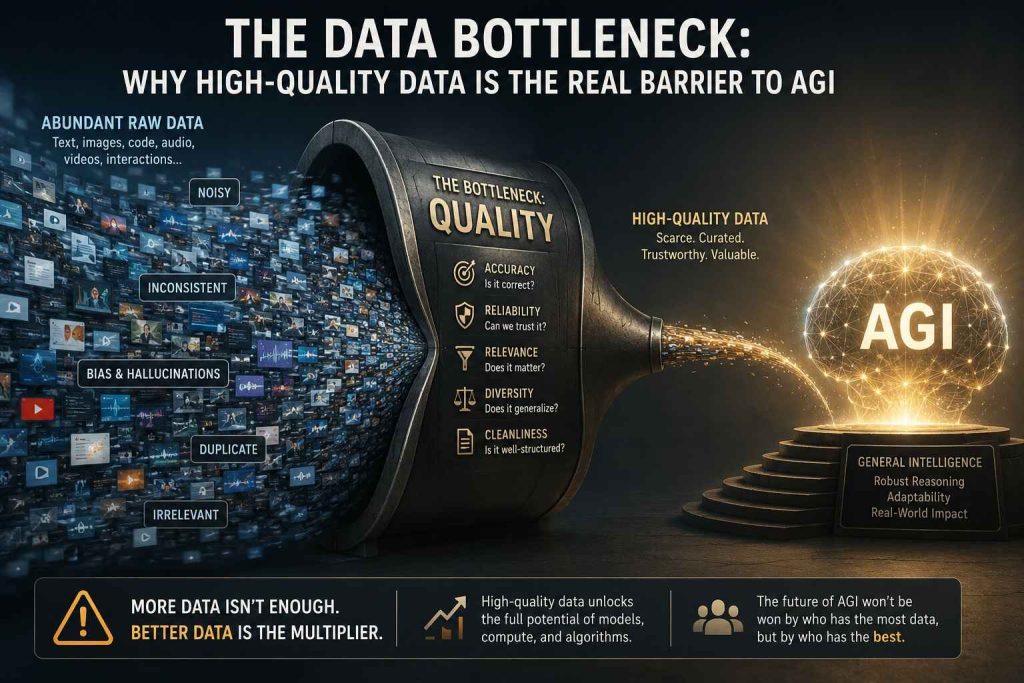
data-bottleneck

The Data Bottleneck: Why High-Quality Data is the Real Barrier to AGI

For years, the dominant narrative in AI progress has been a story about compute. More GPUs. Bigger clusters. Larger parameter counts. And to be fair, it has worked — extraordinarily well. The models produced by scaling compute over the past decade have surpassed nearly every prediction made about them. But a quieter problem has been

The Data Bottleneck: Why High-Quality Data is the Real Barrier to AGI Read More »

What is Multimodal AI? And Why Your Training Data Strategy Needs to Evolve

AI is no longer just reading text or looking at pictures. It is doing both at once — and much more. The models making headlines today — from GPT-4o to Gemini to Claude — don’t think in one modality. They see, listen, read, and reason across all of it simultaneously. This shift from single-mode to

What is Multimodal AI? And Why Your Training Data Strategy Needs to Evolve Read More »

Top 5 Mistakes in Audio Transcription for AI Training (and How to Fix Them)

Voice is everywhere in AI. Speech recognition engines, voice assistants, call center analytics, meeting summarizers, podcast search tools, multilingual LLMs — all of them depend on one foundational ingredient: high-quality transcribed audio data. Yet audio transcription remains one of the most underestimated steps in the AI training pipeline. Teams invest heavily in model architecture, compute,

Top 5 Mistakes in Audio Transcription for AI Training (and How to Fix Them) Read More »

How to Choose an AI Data Annotation Partner: 7 Questions to Ask Before Signing

Your AI model is only as good as the data it learns from. You already know that. What many teams discover too late is that their annotation partner — the company labeling that data — can quietly determine whether a model ships on time, performs in production, or quietly fails in the real world. With

How to Choose an AI Data Annotation Partner: 7 Questions to Ask Before Signing Read More »

Speeding Up Model Training with Better Labeled Data

Artificial intelligence teams often assume that slow model training is a compute problem. They upgrade GPUs.They tweak hyperparameters.They redesign architecture. Yet the real bottleneck is frequently something far less visible: Labeled data quality. If your AI models are taking too long to converge, requiring repeated retraining cycles, or failing to hit accuracy benchmarks, the issue

Speeding Up Model Training with Better Labeled Data Read More »