
Every AI team eventually asks the same question before a real project gets budgeted: what will it actually cost to build the dataset this model needs? It’s a harder question than it sounds, because “building a dataset” is not one line item — it’s sourcing, annotating, validating, storing, and managing data, and each of those steps has its own cost drivers.
This guide breaks the full cost of building a custom AI training dataset into its component parts, with real budget ranges by dataset size and modality, so you can plan a realistic number before you talk to vendors. If you’ve already scoped your annotation needs and just want labeling rates, our companion guide on data annotation pricing in 2026 covers per-image, per-hour, and per-project rates in detail. This post zooms out to the full dataset build — collection through delivery.
What “Building a Custom Dataset” Actually Involves
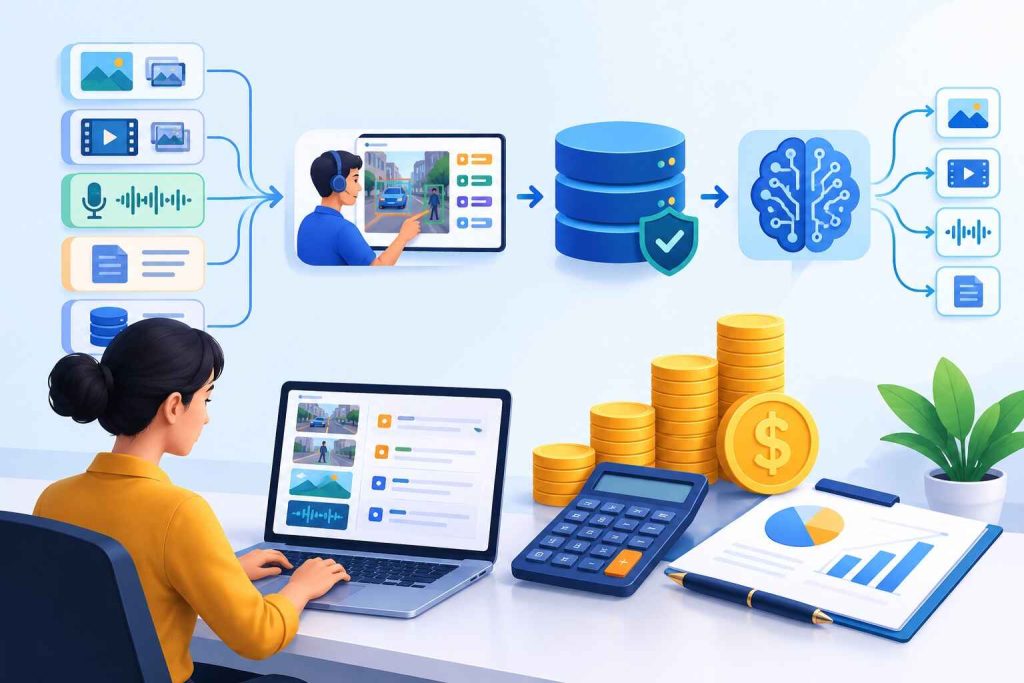
A production-ready training dataset is the output of several distinct workstreams, not a single purchase. Our step-by-step guide to building a machine learning dataset walks through the process end to end, but at a budgeting level it breaks into five cost centers:
- Data sourcing or collection: acquiring raw data through licensing, web collection, field recording, or participant recruitment.
- Annotation and labeling: having humans (and sometimes models) apply the labels, transcripts, or tags your model needs to learn from.
- Quality assurance: validating annotation accuracy through review passes, inter-annotator agreement, and gold-standard checks.
- Infrastructure and tooling: the annotation platform, storage, and data pipeline that moves data from raw to model-ready.
- Project management and compliance: guideline development, vendor coordination, and privacy or legal review.
Skipping or underfunding any one of these doesn’t make the cost disappear — it just shows up later, usually as a rework cycle or a model that underperforms in production.
It also helps to be clear about which stage you’re actually budgeting for. Some teams already have raw data sitting in storage and only need annotation — in which case sourcing costs drop out of the equation entirely. Others are starting from nothing and need every stage funded, including recruiting participants or licensing source material before a single label gets applied. Knowing which scenario you’re in changes your total budget far more than any single per-unit rate does.
The Big Cost Drivers Behind Dataset Pricing
Four variables explain most of the price difference between a $5,000 dataset and a $500,000 one:
- Modality: text and image datasets are generally the least expensive per sample; audio and video cost more because collection and review take real time, not just clicks.
- Volume and diversity: a dataset that needs to cover rare edge cases, multiple demographics, or several languages costs more than one drawn from a narrow, homogeneous population.
- Domain expertise: medical, legal, and financial datasets require subject-matter experts rather than general-purpose annotators, which raises both collection and labeling costs.
- Compliance and privacy requirements: datasets involving personal, medical, or biometric data need consent management, de-identification, and legal review baked into the process.
These same variables show up in specialized contexts: our guides on multilingual speech datasets and accent coverage, medical data annotation as the gold standard for healthcare AI, and sensor data labeling for autonomous vehicles all show how domain complexity multiplies dataset cost well beyond a generic per-sample rate. And if personal data is involved, our overview of data privacy compliance for AI training data outlines the compliance steps that need to be budgeted in from day one, not bolted on afterward.
Cost Breakdown by Dataset Component
Across most custom dataset projects, spend follows a fairly consistent pattern by category, even though the absolute numbers vary enormously by scale:
| Cost Component | What It Covers | Typical Share of Total Budget |
|---|---|---|
| Data sourcing / collection | Recruiting participants, licensing existing data, recording sessions, web/field collection | 20% – 40% |
| Annotation & labeling | Human labeling, review, and correction across your chosen modality | 35% – 55% |
| Quality assurance & validation | Inter-annotator agreement checks, gold-standard review, adjudication | 10% – 20% |
| Infrastructure & tooling | Annotation platform licensing, storage, data pipeline engineering | 5% – 15% |
| Project management & compliance | Vendor coordination, guideline development, privacy/legal review | 5% – 10% |
For the annotation slice of this budget specifically, see our detailed per-image, per-hour, and per-project pricing benchmarks. For the tooling slice, our comparison of AI data annotation tools, features, and costs breaks down what popular annotation platforms charge in licensing fees.
Sample Budget Ranges by Dataset Size
The table below gives directional cost ranges for a full dataset build — collection, annotation, QA, and management combined — at four common project scales.
| Dataset Size | Typical Use Case | Image/Text Dataset | Audio/Video Dataset |
|---|---|---|---|
| Small pilot (1,000–5,000 samples) | Proof of concept, feasibility test | $500 – $4,000 | $2,000 – $12,000 |
| Mid-size (25,000–100,000 samples) | Model fine-tuning, MVP launch | $8,000 – $45,000 | $25,000 – $150,000 |
| Large-scale (250,000–1M samples) | Production model, broad coverage | $40,000 – $220,000 | $150,000 – $750,000 |
| Enterprise / continuous pipeline | Ongoing retraining, multiple markets | $250,000+ / year | $750,000+ / year |
These ranges assume a moderate-complexity task. Add 30-80% for high domain-expertise work (medical, legal, financial), rare-edge-case coverage, or strict multilingual requirements, and expect a discount of 15-30% for very simple, high-volume, single-language tasks.
How Timeline Affects Dataset Cost
Turnaround time is an underrated cost driver. Compressing a project timeline forces a vendor to add annotators, run parallel shifts, or pay overtime rates, all of which raise the per-unit cost even when the task itself hasn’t changed. A dataset that would cost $30,000 on a standard six-week timeline might cost $40,000-$45,000 compressed into two weeks, simply because of the staffing required to hit that pace without sacrificing quality.
The inverse is also true: teams that can commit to a steady, predictable volume over a longer period — rather than one large rush order — typically unlock meaningfully better per-unit pricing, because the vendor can plan capacity instead of scrambling to scale up and back down.
Ways to Reduce Dataset Costs Without Sacrificing Quality
Once you understand where the money goes, there are legitimate ways to bring the total down without cutting corners on the data your model actually needs:
- Start with a pilot batch: validate labeling guidelines on a small sample before committing to full volume, so you’re not paying to relabel a large dataset after discovering an ontology problem.
- Prioritize active learning: use model-in-the-loop sampling to identify which unlabeled examples will improve performance most, rather than labeling your entire raw dataset uniformly.
- Reuse and augment where possible: combine a smaller human-labeled core dataset with synthetic augmentation for common cases, reserving human annotation budget for edge cases and ambiguous examples.
- Commit to steady volume: as noted above, predictable ongoing volume typically earns better per-unit rates than sporadic rush orders.
- Tighten your guidelines upfront: ambiguous labeling instructions are one of the most common causes of costly rework; time spent refining guidelines before launch pays for itself quickly.
Build vs. Buy vs. Outsource: Which Approach Costs Less?
Three paths exist for acquiring a training dataset, and each has a different cost profile. Licensing an existing dataset is usually cheapest upfront but rarely matches your exact task or domain. Building in-house gives you full control but requires fixed investment in recruiting, training, and tooling regardless of project volume. Outsourcing to a specialized vendor shifts most of that fixed cost into a variable rate tied to actual work delivered. Our comparison of data annotation outsourcing vs. in-house teams covers this trade-off in depth, including the scenarios where an in-house team still makes sense.
Synthetic data generation is a fourth option worth considering for specific use cases. Our analysis of synthetic data vs. human data for AI training explains where synthetic data can meaningfully cut collection costs — and where it introduces validation risk that ends up costing more than it saves.
The Hidden Cost of Underbudgeting Dataset Quality
The most expensive dataset is the one you have to rebuild. Teams that choose the lowest-cost vendor without checking annotation quality controls often discover the problem only after a model underperforms in production. Our analysis of the real cost of bad training data and AI production failures quantifies just how much more expensive a failed launch is compared to the upfront savings of a cheap dataset, and our related piece on garbage-in-garbage-out data quality issues covers the specific failure patterns to watch for. Building in a proper QA budget — typically 10-20% of total spend, as shown in the breakdown above — is consistently cheaper than the alternative.
It’s also worth budgeting time, not just money, for quality validation. Our guide on evaluating data annotation quality with the right QA metrics outlines the specific measurements — inter-annotator agreement, gold-standard accuracy, error rate by category — that tell you whether a dataset is actually ready to train on.
How to Budget Accurately Before You Request Quotes
Before you approach vendors for pricing, gather the inputs that actually determine cost:
- A representative sample of your target data, or a clear description of what you need collected.
- Your target dataset size, and whether it’s a one-time build or an ongoing pipeline.
- Your accuracy or quality threshold, and how it will be measured.
- Any domain expertise, language, or compliance requirements specific to your use case.
- Your timeline, including whether a pilot batch is needed before full-scale commitment.
Our checklist for choosing a data annotation partner and guide on how to choose the right AI data annotation partner both walk through the vendor evaluation questions that separate an accurate quote from a number that will grow once the real edge cases show up. It’s also worth reviewing our roundup of the best AI data providers in 2026 to compare scope and pricing approach across vendors before committing.
How Synnth AI Scopes Custom Dataset Projects
Synnth AI builds custom training datasets end to end — sourcing, annotation, and QA — across image, text, speech, and video data. Rather than quoting off a generic rate card, every engagement starts with a scoping call and a small pilot batch — typically delivered in 48-72 hours — so you can see real quality and real cost before committing to full-scale production.
If you’re ready to get a project-specific number, request a free quote from Synnth AI and share your data sample, target volume, and timeline — no obligation, no generic estimate.
The Bottom Line
There’s no single answer to “how much does a custom AI training dataset cost” — the honest range spans from a few hundred dollars for a small pilot to well over a million for an enterprise-scale, multi-modal, continuously updated pipeline. What stays consistent is the structure of the cost: sourcing, annotation, QA, infrastructure, and management, in roughly that order of magnitude. Budget for all five, ask vendors to break down their quote the same way, and validate quality with a pilot batch before you commit to full-scale spend.
The teams that end up happiest with their dataset spend are rarely the ones who found the absolute cheapest per-unit rate. They’re the ones who understood which cost components applied to their specific project, asked vendors to itemize rather than bundle those costs, and treated the pilot batch as a real checkpoint rather than a formality on the way to a number they’d already decided on.
Frequently Asked Questions
What is the average cost of building a custom AI training dataset?
It depends heavily on scale and modality. A small pilot dataset of a few thousand text or image samples can cost as little as $500–$4,000, while a production-scale dataset of hundreds of thousands of samples across audio or video can run into the hundreds of thousands of dollars. Most mid-size fine-tuning projects fall somewhere between $8,000 and $150,000.
What’s the difference between data annotation cost and dataset build cost?
Data annotation pricing covers only the labeling step — assigning tags, boxes, or transcripts to existing data. Building a custom dataset from scratch also includes sourcing or collecting the raw data, quality assurance, infrastructure, and project management, all of which add to the total. Our breakdown of data annotation pricing covers the labeling piece specifically.
Is it cheaper to use synthetic data instead of collecting real data?
Synthetic data can lower costs for certain tasks, particularly where real-world data is scarce, sensitive, or dangerous to collect, but it isn’t a universal cost-saver — it requires careful validation against real-world performance and often works best blended with human-collected data rather than as a full replacement.
How much does data collection cost compared to annotation?
Data collection typically accounts for 20-40% of total dataset budget, with annotation making up the largest share at 35-55%. Collection costs rise sharply when you need rare scenarios, specific demographics, multiple languages, or field recording rather than data that already exists.
What size dataset do I actually need before I start budgeting?
It depends on your model architecture, task complexity, and current performance gaps. Most teams are better served starting with a small pilot batch to validate labeling quality and model lift, then scaling volume based on measured performance improvement rather than guessing at a target dataset size upfront.
Can I reduce dataset costs by outsourcing instead of building an in-house team?
For most organizations, yes. Outsourcing avoids the fixed costs of recruiting, training, and managing an internal data team, and lets your spend scale with actual project volume. Our comparison of outsourcing versus in-house annotation covers the full cost trade-off in detail.
What happens if I underinvest in dataset quality to save money?
Cutting corners on data quality is one of the most expensive mistakes in AI development — poor-quality training data leads to underperforming models, costly retraining cycles, and in some cases production failures that are far more expensive to fix after launch than the savings from a cheaper dataset upfront.
How do I get an accurate cost estimate for my specific dataset?
Share a data sample, your target volume, your quality and accuracy requirements, and your timeline with a vendor. A specialized provider like Synnth AI can then scope a pilot batch and full-scale quote based on your actual data rather than a generic industry average.
Does a faster timeline always cost more?
Usually, yes. Compressing a delivery timeline typically requires a vendor to add annotators or run parallel shifts, which raises the effective per-unit cost even though the task itself hasn’t changed. Committing to a steady, predictable volume over a realistic timeline generally earns better pricing than a rush order.